All posts by GGaurav

Unknown's avatar

About GGaurav

I am passionate about old movies, songs and trivia.

Ha Khel Savlyancha (1976)

Ha Khel Savlyancha (1976) is a Marathi language movie and the title means “Game of Shadows.” I had heard about this movie for many years and finally had the chance to watch it recently. The Marathi movie falls in the thriller/mystery/haunting movie genres which were not explored much in the era when the movie was released. So kudos to Vasant Joglekar, the director for making this attempt. The movie was made under his own banner.

Yes, we have a haunted haveli (mansion), a haunting song, a terrified heroine, a stepmother, a sensible hero, and lots of fun on the menu!

The Plot

Indumati “Indu” (Asha Kale) is a rich heiress but aware of the responsibility brought along by wealth and status. She likes to spend time with the villagers, working in the fields and sharing meals with them. Her widowed step mother played by Lalan Sarang admonishes her but Indu has her answers ready. Diwanji Moropant (Dhumal), a tenured employee is the other major character in the house.

Lalan is worried that Indu has come of age and is now the rightful owner of the property. She will not be able to continue enjoying the financial freedom she has been used to since Indu’s father’s death. Can this be fixed in any way?

It is time to find a suitable match for Indu. Dr Shekhar (Kashinath Ghanekar) comes to visit along with his parents (Ashok Kumar and Sumati Gupte in cameos). Coincidentally, Shekhar has come across Indu earlier in the village. Indu had met him as a simple village girl called “Gomu” (with attire and accent to match!). The impersonation is soon sorted out and the lovebirds Shekhar and Indu agree to get married. 

Meanwhile, Lalan’s brother Ganu (Raja Gosavi) has also come to stay uninvited in his rich relative’s mansion. The unemployed Ganu has been an actor in Marathi musical dramas and keeps reciting dialogues and songs from old musical plays. Indu likes him because of his funny nature and he provides comic relief.

All is well when tragedy strikes. The ghost of a servant who had died, apparently returns to haunt Indu. Time for a flashback.

We come to know that many years back as a child, Indu was stubbornly requesting for fresh coconut water during a rainstorm. One of the servants Narsu agrees to climb the tree in spite of the storm and pick the coconut. He succeeds but loses his life falling off the tree and hitting a stone. This leaves his wife (Sanjivani Bidkar?) crushed. It is believed his ghost resides in the same tree and his wife keeps singing a haunting song “Kaajal raatin” from time to time. To pacify the ghost, the household offers daily bhog (prasad).

In the coming days, Indu keeps seeing Narsu’s apparition in front of her window and gets terrorized. Has the ghost arrived to seek revenge? Somewhere deep down, she blames herself for Narsu’s death. Her condition deteriorates rapidly and things may soon go out of control.

Her mother and diwanji would like to continue with traditional cures (meaning calling an exorcist to exorcise the ghost). On the other hand, Dr Shekhar wants to employ scientific medical methods and cure Indu permanently.

What happens next? Is the ghost exorcised, will Indu ever be normal? or a mental asylum will be the best option for her? And what about Dr Shekhar?

The Music

Sudhir Moghe (lyricist) and Hridaynath Mangeshkar (music director) share the honours.

The film begins with a beautiful song in the rice fields “Aala aala wara” by Asha Bhosle and Anuradha Paudwal.

Gomu sangatin is a catchy song by Hemant Kumar and Asha Bhosle. The only jarring note is Kashinath Ghanekar in a gaudy costume accompanied by weird choreography.

The title song comes later in the movie and is ably used in the context of the scene and condition of the heroine at the time. Mahendra Kapoor sings the song.

And finally the haunting song “Kaajal raatin” (singer: Asha Bhosle). The song comes at regular intervals and achieves its intention – to scare the audience and leaves a lasting impression.

My Thoughts

Firstly, as mentioned this genre was not much explored in Marathi cinema when the movie was released. I am not sure if the movie has been inspired from a Hindi or other language movie. Well known writer Madhusudan Kalelkar and Sumati Gupte (who was also the producer) share the writing credits. Vasant Joglekar’s direction succeeds in keeping the viewer hooked till the end when the suspense gets revealed. The film is taut and engaging. The songs are too good and complement the story.

Asha Kale is widely known for her self-sacrificing sobby roles image in Marathi movies. This movie is a revelation. From the practical, happy go lucky rich heiress to the desperate haunted girl, she is most impressive. She brings out the transition of the character and its vulnerability very well. And she dances well in a couple of songs (she was a trained dancer), something which she rarely gets to do in her other movies.

Dr Kashinath Ghanekar was a superstar on Marathi stage. While the initial scenes seems a bit awkward including the dancing part, he performs effortlessly as the doctor supporting and treating his would be wife.

The supporting cast is good including veterans Dhumal and Madhu Apte. Lalan Sarang is impressive as the stepmother torn between the love for her step child and greed for the estate and comfort. But thankfully she is not shown as an evil stepmother which is the norm in movies. Raja Gosavi offers comic relief and excels as the out of job actor wanting a comfortable life in his sister’s house.

Ashok Kumar and Sumati Gupte offer entertaining cameos. Same for Deven Verma who plays an exorcist Bhoot Papeshwar. Jairam Kulkarni appears in one scene as a tonga driver (tangewala) and this marked his debut in movies.

Singapore (1960)

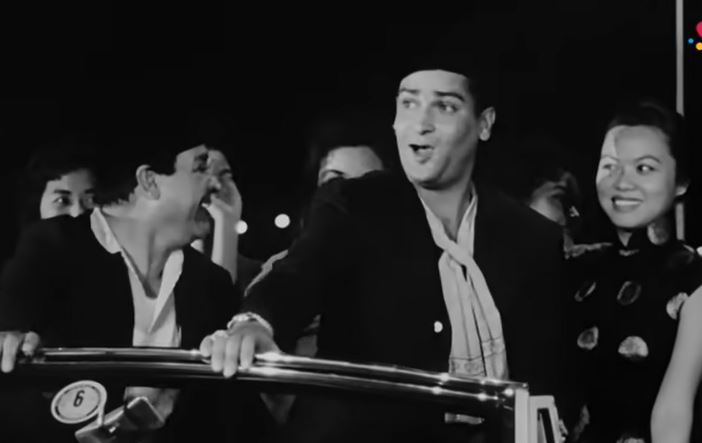
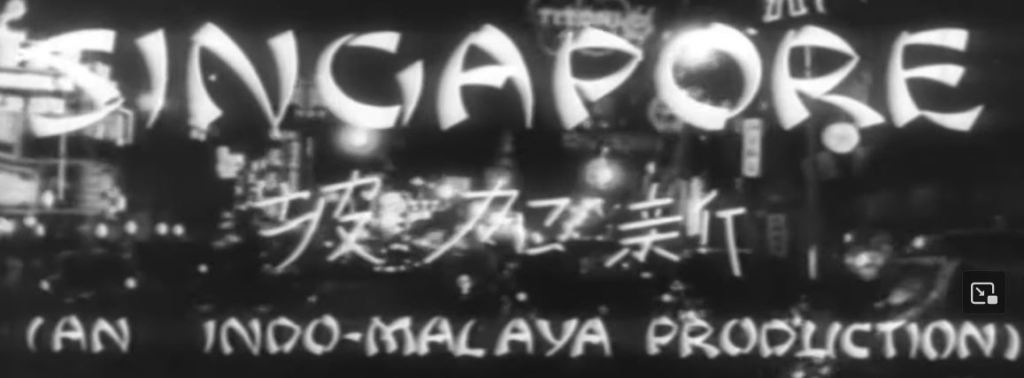
Singapore is a 1960 Hindi movie. It is an Indo Malaya production directed by Shakti Samanta. One of the first movies shot extensively outside India, the story is based totally in Singapore.

The Plot

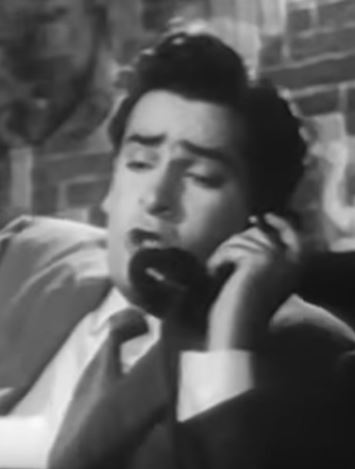
Shyam (Shammi Kapoor) lives in India and is planning to sell his rubber estate in Singapore. His estate manager Ramesh (Gautam Mukherjee) is working on the details. Ramesh has found out that there is an old treasure hidden somewhere in the estate. He has written multiple times to Shyam but not received a response. He finally manages to speak to him and is about to share the information when he sees someone outside his cabin. The call is cut. Ramesh disappears and Shyam decides to visit Singapore to sort the matter himself.

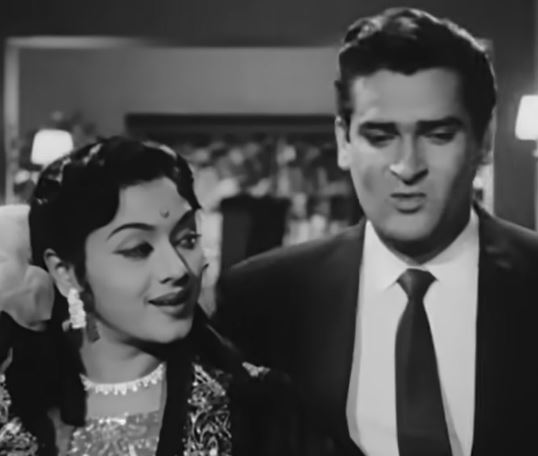
We are introduced to Shobha (Shashikala) who was Ramesh’s friend and her cousin sister Lata (Padmini). Both are dancers in New India club owned by Lata’s uncle Shivdas (K.N. Singh). Shivdas seems to be a shady character and has an interest in Shyam’s rubber estate and the treasure. Cha Choo (Agha) who is working in Shyam’s Singapore office as secretary becomes his able(!) sidekick in the investigation.

Shyam also meets Maria, played by Malay actress Maria Menado who had sat beside him during the flight and later helps him in Singapore.

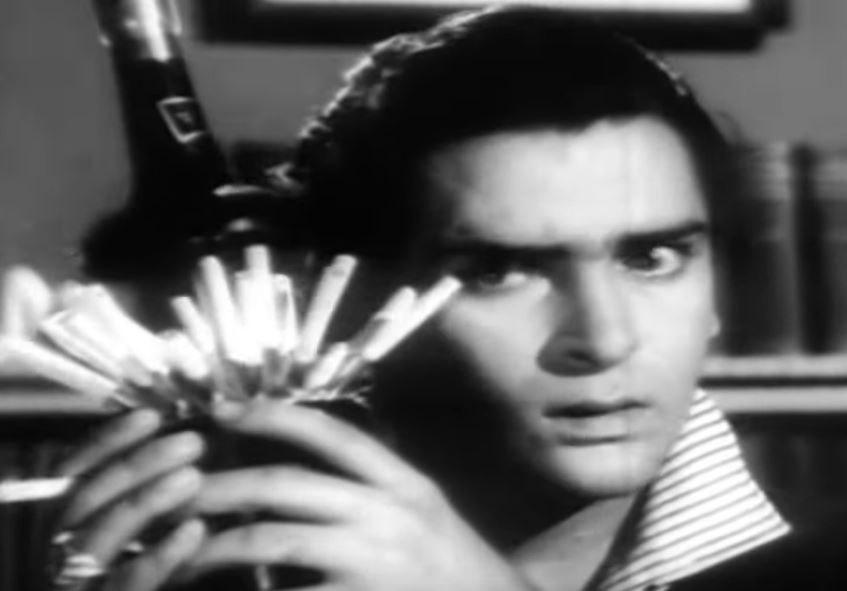
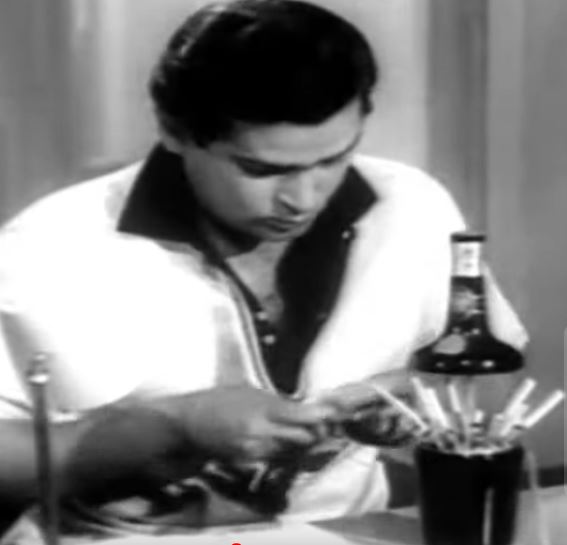
The first half is interesting. Shyam, along with Cha Choo hunt for the treasure map, cleverly hidden in a cigarette holder cum Vat 69 bottle by Ramesh. He befriends Lata and gets romantically involved with her. Shivdas arranges a picnic to the rubber estate hoping to find the treasure. But the story takes a twist here with Shivdas getting murdered and Shobha getting abducted by the gang who is after the treasure. It is revealed Ramesh is alive and held hostage by the same gang.

So, who is behind all this? The latter half of the movie gives the answers but not without Hindi movie staples including too many songs, disguises, car chases and a long-winded climax involving helicopters, a ship, boats, police jeeps and the unmasking of the villain.

The Music

Singapore had 8 songs composed by Shankar Jaikishan who were in their prime during this period with lyrics penned by Hasrat Jaipuri & Shailendra. But three of them are more memorable.

The title song by Mukesh is quite famous (Ye shehar bada albela) but somehow lacks the vibes of later songs like Love In Tokyo and An Evening in Paris. This seems a bit subdued in comparison.

Another song that stands out is Lata Mangeshkar singing for Maria Menado. The lyrics can be a catchline for Singapore tourism!!

 Dekho ji dekho sun lo ye baat, jeevan mein ek baar aana Singapore…

Its difficult to believe its Lata Mangeshkar singing, she sounds so different and the music is equally delightful.

And the third song is Rasa Sayang re picturised on Shammi Kapor and Helen, with both actors having lot of fun here. “Rasa Sayang He” is a well known traditional Malay song talking about the feeling of love.

My Thoughts

Shakti Samanta has given some all time great movies and this offering pales a bit in comparison. The film starts on a promising note but somehow falters. There are suspense elements like  the discovery of the map, Shivdas’s body’s disappearing and reappearing, entry of the masked villain. But somehow the plot points don’t add up seamlessly making the movie a tedious watch. The chemistry between Shammi Kapoor and Padmini is strikingly lacking and the romantic songs offer little help. Shammi Kapoor is most entertaining as he gets to be in various modes – romantic hero, investigator, disguised dancer and comedian. Wish the other characters too were used to their full potential.

Nevertheless, Singapore will be remembered for its outside India location and effort. Do watch if you need a glimpse of old, old Singapore!

Parichay (1972)

Parichay (meaning introduction or acquaintance) is a Hindi movie heralded by Gulzar (writer, director, screenplay, lyricist, and the intro voice-over). Heavily inspired from the English classic The Sound of Music (1965), it is nevertheless a good and entertaining movie in its own right.

The Plot

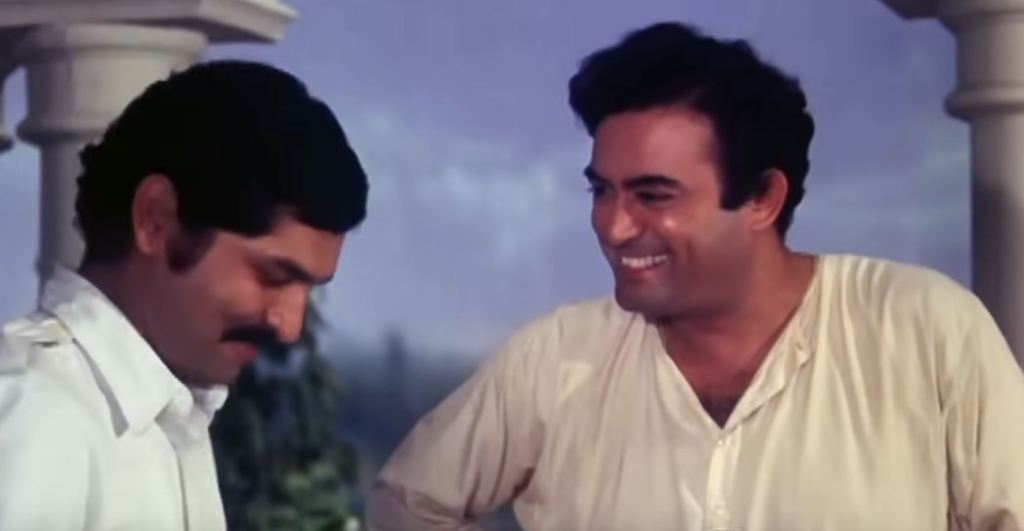
We are introduced to Pran (Rai Saheb), a retired colonel. Rai Saheb is a strict disciplinarian and a principled man and expects others to follow the same line. Rai Saheb’s only son Nilesh (Sanjeev Kumar) had left his house 17 years ago. He was a worthy singer who wanted to pursue music as his life’s passion much to Rai Saheb’s chagrin.


Circumstances force Nilesh to marry his guru’s daughter Sujata (Gita Siddharth). Upon coming home to meet his father, Rai Saheb makes it clear there is no place for him, his wife and their music in his mansion. He is free to take as much money as he wants and settle down in his “own” house.

Being the son of his principled father, Nilesh leaves empty handed and never to return.

The years that follow have been hard on Nilesh and his family. His wife has passed away leaving behind 5 children namely Rama (Jaya Bhaduri) and Ajay, Vijay, Meeta and Sanjay. Nilesh himself is terminally ill.

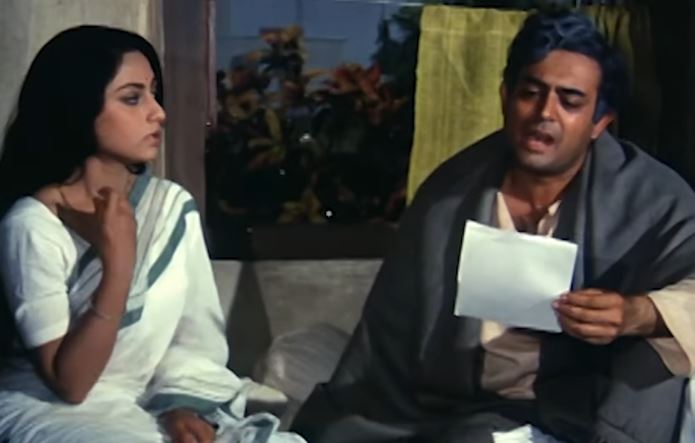
As a last resort before dying, he writes to Rai Saheb to come and take the children with him. This will help in securing their future. Unfortunately, Nilesh dies before Rai Saheb arrives. After much pleading by Rai Saheb, the children agree and come to stay with him.

The children detest their grandfather and it is their constant endeavour to be non-cooperative. Their top priority is to ensure that none of the “masters” (tutors) employed by their grandfather are successful in their attempt to teach and discipline the children. They will use every trick in the trade to make the master flee from his job (to hilarious consequences). Needless to say, Rai Saheb is fed up with this attitude and has to keep looking for replacements.

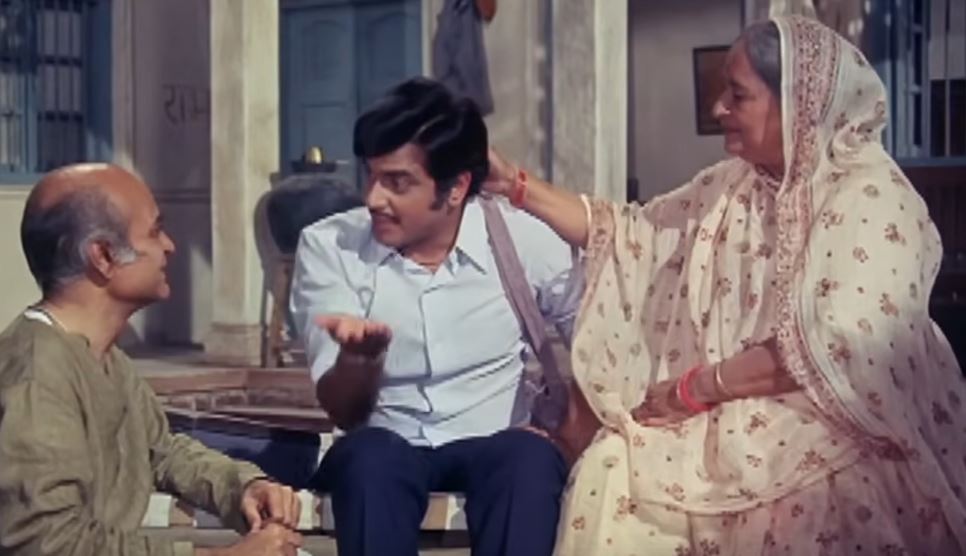
We are now introduced to Ravi (Jeetendra), an unemployed man staying with his roommate Amit (Vinod Khanna) in the city. Ravi’s maternal uncle (A.K. Hangal) writes to him informing him of the teaching job vacancy at Rai Saheb’s mansion. Seeing no option, Ravi agrees to try his luck at this opportunity (he has had some experience in teaching previously).
After he arrives at his uncle’s place, his mamiji (Leela Mishra) warns him the children are “rakshas” and “yamdoot” and it’s better for him to decline the opportunity. Such is the widespread notoriety of the children!

After a tense “interview” scene with Rai Saheb, Ravi gets the job. However, he is soon introduced to his students’ pranks who will spare no effort to make his life hell and force him to run away. But Ravi is a tough nut to crack and handles each situation calmly.
Other characters in the mansion are Rai Saheb’s sister Sati (Veena) and an old servant Narayan (Asrani).

Through Rai Saheb and Narayan, Ravi comes to know the background of Rai Saheb’s relationship with Nilesh and the negative impact it has had on the children. It is upon Ravi to attempt bridging the emotional gap, making it a win-win situation for all the parties. Will he succeed?

The Music

There aren’t many songs but Gulzar and R.D. Burman deliver a memorable score. The sentimental Musafir hoon yaaron sets the tone for the unemployed Ravi seeking an unknown path.
Then there is Beeti na beetai raina, ably sung by Lata Mangeshkar and Bhupinder. Lata Mangeshkar won her first National award for this song.
Bhupinder also gets to sing a short version of Mitwa bole meethe bain.
And finally, a tribute to Do re me from The Sound Of Music – the chirpy Sa re ke sa re, Gulzar’s playful lyrics describing the 7 musical notes.

My Thoughts

There are multiple conflict scenarios in the movie. The first being Rai Saheb and Nilesh. Unfortunately, this conflict ends on a sour note.
The second one is between the grandfather and the children. And the third between Ravi and the children. It’s Ravi’s deft handling and effort that endears him to the children and Rama (romantically, this being a Hindi movie!). And in parallel helps to open a dialogue between Rai Saheb and the children. The gradual transition doesn’t seem forced and Gulzar achieves it convincingly.

Jeetendra is adequate. Jaya Bhaduri is impactful as she plays multiple roles as the daughter of a wronged father, her protectiveness for her siblings and perceptions concerning her grandfather.
Pran shines and he is at his villainous best in some scenes and the misunderstood patriarch and grandfather in others. Sanjeev Kumar is memorable in a special appearance but shows why he went on to have a long association with Gulzar. The supporting cast are equally good.

On a funny note, the movie seems to be shot in and around Panchgani and Mahabaleshwar hill stations in Maharashtra and none of them are connected by railway. However we get to see a railway station in the film’s climax. So much for cinematic liberties! So entertaining!