Category Archives: My Reviews

Ek Daav Bhutacha (1982)

Many years back I had seen the English movie Blackbeard’s Ghost (1968). The movie was about a pirate “ghost” whose spirit is invoked by the hero and how they team up to take upon the opposition. I realised Chamatkaar (1992) starring Naseeruddin Shah and Shah Rukh Khan was inspired from the same film. And it was the inspiration for the Marathi film Ek Daav Bhutacha (One turn/game of a ghost) too. While the setting and characters are different it succeeds in entertaining the viewers. The movie is produced and directed by Ravi Namade.

The Plot

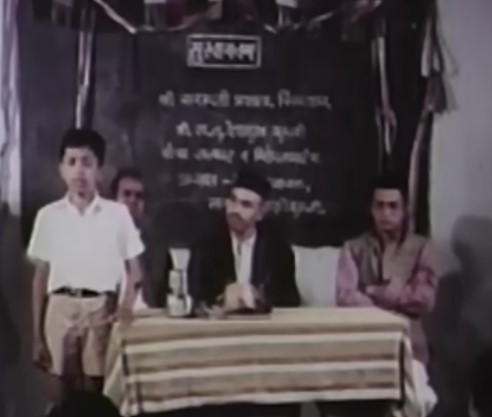
Dilip Prabhavalkar plays a school teacher Sadashiv Tukaram Deshmukh. It’s his farewell function as he has been transferred to another village called Tagewadi. He is warned by the principal that the village is full of crooked characters and difficult for a new teacher to survive. Several teachers have run away from their jobs.

Sadashiv is a simple and meek man. He does not have a family or relatives. Next day, he starts for Tagewadi.
Sadashiv enters Tagewadi and immediately gets a feel of the things to come. 3 men rough him up when he alights from the bus as part of a prank or “timepass.” He is insulted when he goes to a restaurant for a cup of tea. Even the women don’t behave normally. Left to himself, he finally locates the village school.

The school principal (D M Mirasdar) welcomes him. He is asked to settle down in the old school gymnasium. These will be his living quarters. The principal is overjoyed when he hears Sadashiv is a bachelor and invites him for dinner. There is a reason. The principal has a dim witted daughter Shanta who is trying to clear her matriculation exam. The plan is to introduce Shanta to Sadashiv, and slowly plan their marriage.

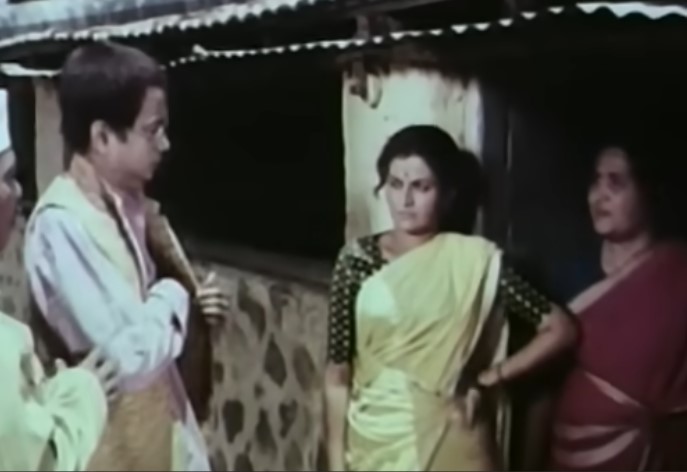
The next day Sadashiv visits the house of Radha mausi (Sulochana). Radha along with her daughter Durga (Ranjana) run a small mess. Durga is a fiery character and makes clear the terms and conditions. Sadashiv accepts and hands over the advance payment. His food problem is solved.
It’s Sadashiv’s first day in school. On the way, he sees a temple and participates in a devotional song. This is a random song (Tuch maay baap bandhu), apparently to show that he he sings well and plays the harmonium too.

He enters the class room to meet his students. The students are bratty like the other villagers, all ready to play pranks and trouble him. Predictably, there is a cartoon of the new teacher drawn on the blackboard. Paper missiles are aimed at him as a welcome gesture. But Sadashiv is a shrewd teacher. He is able to get the class under control by finding the pranksters and warning them.
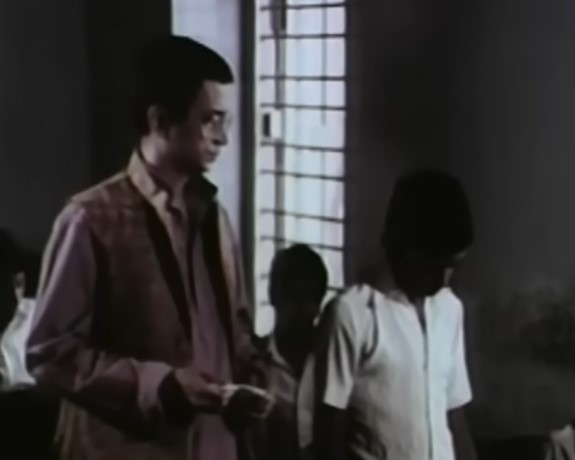
A few weeks pass. Sadashiv gets closer to Radha and Durga. They treat him as a family member after he helps them during Radha’s illness, and when a shady character tries to molest Durga and Sadashiv saves her. Sadashiv and Durga have started taking an interest in each other but both are yet to admit it openly.

Sadashiv settles down in his teacher’s role successfully. The students are under his control and the other teachers wonder how he has managed to do this.
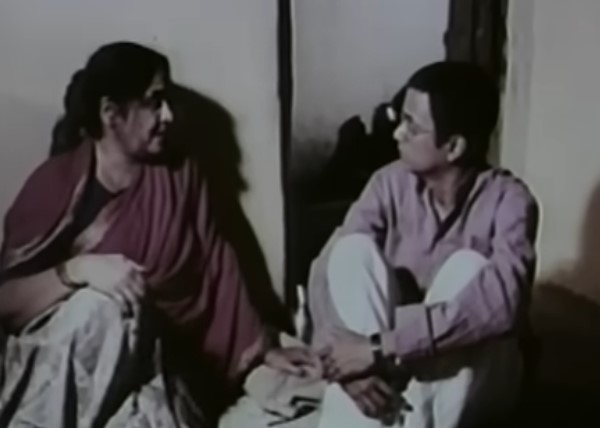
But the crooks in the village will not leave him alone. The village chief (sarpanch) played by Mohan Kothiwan is a dominating character. One day, his son (or nephew) beats a fellow student Shankar and talks rudely to Sadashiv. Sadashiv slaps him and the boy leaves after warning him. Later, the sarpanch’s brother (a wrestler) bursts in Sadashiv’s classroom and threatens him of dire consequences. The sarpanch ensures the other boy Shankar is expelled. Sadashiv is hepless when Shankar’s mother pleads to take him back.

Things take a turn for the worse when the sarpanch invites a dancer Shevanta to perform in the village. When she complains about the accommodation provided, he forcibly evicts Sadashiv from his quarters and assigns them to Shevanta and her troupe. A powerless Sadashiv heads towards an old and abandoned building. He reluctantly settles down for the night.

Sadashiv’s life is about to change. He hears a disturbance and goes to investigate inside the building. He meets a man who introduces himself as Khandoji Farzand (Ashok Saraf). Khandoji was a soldier in Chhatrapati Sambhaji Maharaj’s army some 300 years back. In other words, he is a ghost (or spirit). Sadashiv has had enough of the villagers’ pranks. He tells Khandoji that he seems to be an actor from a drama company and leaves the building.

But Khandoji pursues him. He demonstrates a few tricks to prove he is a ghost. Only Sadashiv can see him and he is not going to leave him alone. Sadashiv asks him why he is wandering as a ghost all these years. Khandoji informs him that he had killed the husband of the girl whom he was in love with. She was the daughter of a sardar (commander) whereas he was a common soldier, a servant. The girl went mad after her husband died. Khandoji was repentant about his actions and his spirit has been seeking redemption ever since. He believes he will achieve it if he is able to conduct a good deed by helping someone. Of course, he cannot do this alone and needs someone in this task. Sadashiv accepts his explanation and from thereon they are inseparable and thick as friends.
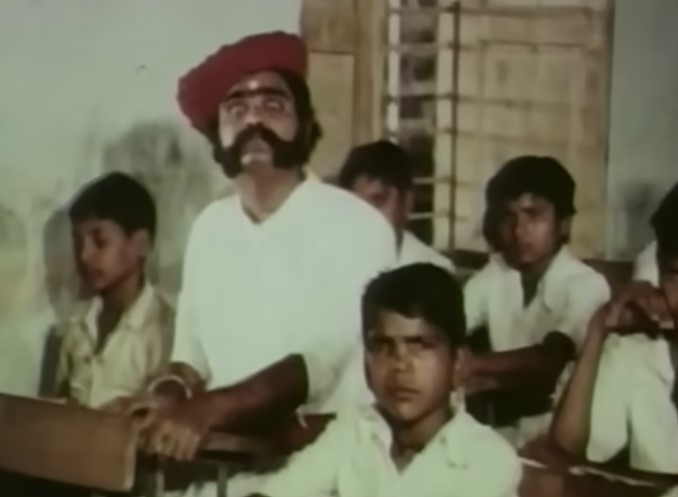
Khandoji helps Sadashiv to tackle his detractors one by one. And you see some special effects on screen accompanied by some amusing scenes. The ghostly actions scare away the dancer and Sadashiv moves back to his residence. Shankar, the expelled student is reinstated. The sarpanch and his cronies are also dealt with and so on.

Most importantly, Khandoji plays a role in bringing together Sadashiv and Durga. But the sarpanch plans to disrupt their marriage and teach them a lesson.

Will he be successful? Will the lovers unite and what is Khandoji’s future? Will he ever be free?

The Music
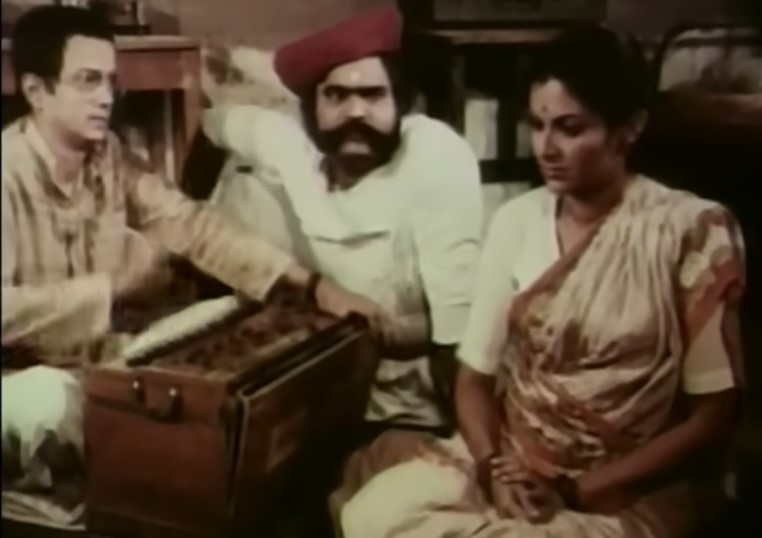
The songs are not that well known. Sudhir Moghe is the lyricist, with music by Bhaskar Chandawarkar. Shrikant Pargaonkar sings the devotional song Tuch maay baap bandhu, and the duet with Anuradha Paudwal, Vishawalli asuni bhavti. Anuradha Paudwal renders the romantic solo Mee fasle, whereas Usha Mangeshkar sings the lavani Aho raya mala rang mahalaat thewa.

My Thoughts

The story, screenplay and dialogues are by well known writer D M Mirasdar. He also acts in the movie. The story is good and the dialogues are crispy and witty. Considering other films of the times, the subject is different. Wish there were more entertaining special effects but I think that depends on the movie’s budget. The weak production values are evident. However, the effort is worth a watch.

Dilip Prabhavalkar, Ranjana, Ashok Saraf and Sulochana share the acting honours. Their acting is natural and effective. The chemistry between the leads is convincing though Dilip and Ranjana would be considered an odd lead pair. Dilip and Ashok’s give and take are hilarious, both being such splendid actors. The supporting cast consisting of known names like Mohan Kothiwan, Mohan Joshi, Ram Nagarkar, Shriram Ranade and Raghvendra Kadakol are convincing.

Amar Bhoopali (1951)

Amar Bhoopali (loosely translated as The Immortal Song) is regarded as one of the best movies of V Shantaram. V Shantaram was a pioneer filmmaker in Hindi and Marathi cinema, leaving his impression with movies covering socially relevant and offbeat subjects.

In Amar Bhoopali, he presents the story of Honaji Sayaji Shilarkhane, popularly known as Kavi Honaji, a poet in Maharashtra circa late 18th and early 19th century. Honaji performed his compositions (lavanis and powadas) with his friend Bala Karanjikar and they became famous as the Honaji Bala duo.

The film is set in the period of Peshwa Bajirao II and includes events surrounding the eventual decline of the Maratha Empire or Confederacy. It stars Pandit Rao Nagarkar in the title role along with Sandhya, who passed away recently.


The Plot

Honaji (Pandit Rao Nagarkar) is a cow herder (gawali) staying in Saswad with his wife, mother Vithabai (Lalita Pawar) and friend Bala (Bhalchandra Pendharkar).

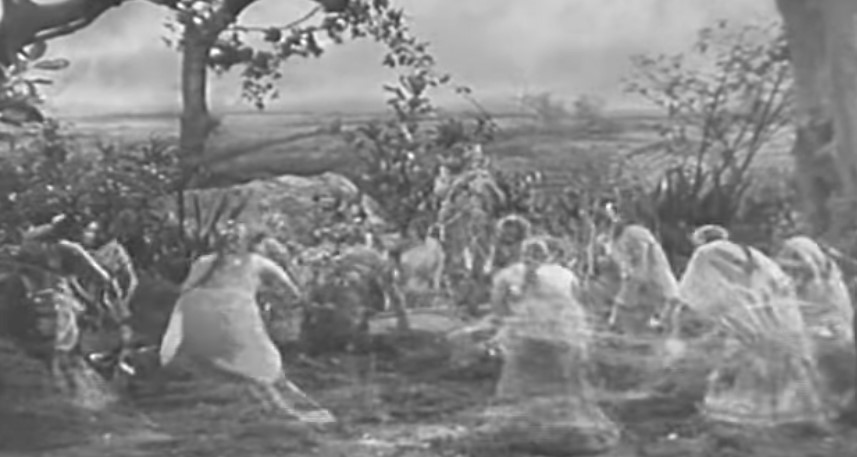
Honaji is a poet at heart. One day, in the temple, Shastribua is narrating the story of Lord Krishna and the gopis, engaged in Ras Leela. Honaji is nearby tending the cattle. He is moved by the narration and visualizes the gopis dancing in front of Krishna. Its as if the scene is happening in front of him. As Krishna leaves, all the gopis have the same question “Sanga Mukund kuni haa pahila?” meaning, has anyone seen Lord Krishna? An inspired Honaji presents his poem in front of Shastribua, who is highly impressed by its spontaneity and content.

When Vithabai arrives, Shastribua asks her to bless her talented son. Vithabai agrees but she is not in a good mood. Honaji has forgotten to bring the cows home (this seems to be a frequent occurrence given Honaji’s tendency to roam around and immerse in poetry).

Honaji’s uncle is also angry with his actions. The neighbours are complaining about the cows entering their fields and feasting on the crop. His uncle orders him to leave Saswad immediately and go to his house in Poona (now Pune). Left with no choice, the family proceeds towards Pune the same night.

The approaching dawn inspires Honaji to sing another song describing the sunrise. This is the all time great “Ghanshyam sundara” which appears multiple times in the movie.

The scene moves to Pune. Vithabai’s family is assigned the prestigious task of delivering milk to the Peshwa’s residence.

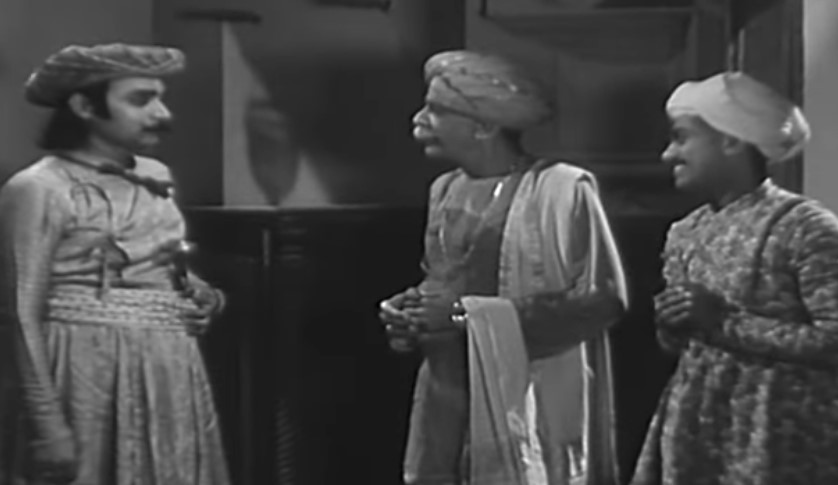
Honaji’s uncle Bala Bhairu is a “Shahir” and a tamasha (a traditional form of Marathi theatre, comprising of singing and dancing) artist. His uncle has received invitation from none other than the Peshwa Bajirao (chief minister of the Maratha empire) and wants Honaji to accompany him. Vithabai makes it clear that Honaji is to stay away from tamasha. There are happy with their cows and their profession. Honaji agrees.

In the meantime Honaji’s friend Bala arrives. Bala is a tailor by profession but is more focused on being a tamasha artist and start his own tamasha company (phad). He is scheming to make Honaji join him.

Next day, Bala visits Gunawati, a classical singer. But there are hardly any patrons who come to listen to her pure (and seemingly heavy) classical singing. Bala has told her multiple times to sing lavanis going with the current trend (Lavani is a traditional folk art form of Maharashtra, India, that combines song, dance, and theatrical expression). Gunawati is contemplating the suggestion but doesn’t want to sing cheap numbers.

At the same time, Vithabai and Honaji are going towards the “wada” (Peshwa’s residence) to deliver milk. They have to pass through a street lined with houses of tamasha performers. Vithabai is aghast to hear the lavanis falling on their ears. She asks Honaji to sing Ghanshyam sundara, the same composition he was singing on their way to Pune. He obliges. Gunawati hears him when they are passing below her house. She is mesmerized by the lyrics, pitch and melody. She would be more than happy if she can sing a lavani which has a raagdari or classical base.

Bala tells her about Honaji. He is a talented poet but is unspoiled and unadulterated, a simple man. She needs to meet him, impress him and inspire him to bring out his talent and compose lavanis befitting his stature. She agrees to meet Honaji. Her mother agrees too.

Gunawati poses as a respectable woman on her way to perform a pooja. By chance, she is about to meet with an accident and Honaji rushes to save her. She skillfully drives the conversation to music and poetry. He is absorbed by her looks and singing. He recites a new song Ghadi ghadi are Manmohana.

They meet multiple times. She keeps learning new songs from him and performs them for her patrons, who throng her house in greater numbers. The credit of course goes to Honaji, who is unaware of the reality.

Meanwhile, the Peshwa’s wife is impressed by Honaji’s singing. She gifts him a piece of pasture land hoping he will maintain the purity of his compositions and stay away from other influences (implying lavanis).

At this stage there is a bit of information shared on the political happenings in Pune. At Shaniwar Wada (the fortress of the Peshwas), the secretive discussions around the next offensive on the Moghuls have been replaced by a continuing presence of tamasha dancers entertaining the rulers. The royal treasury is being utilised to shower gifts on the dancers. The British are keeping a watch on the happenings in Pune, waiting for an opportunity to strike as the Peshwa’s hold weakens.

Sardar Yeshwant Holkar is itching to revenge his brother’s death who was killed on the Peshwa’s orders. He has deputed his Subhedar (Vikas) to meet Ramaji Naik (Bandopant Sohoni), the moneylender to seek his funds and support. He is aware that all is not well in the Pune durbar which is under the grip of music and tamasha. The Holkars are planning to attack Shaniwar Wada and loot Pune. They also need the support of the tamasha troupes to achieve their mission.

Subhedar goes to meet Gunawati. She presents Latapat latapat, a catchy lavani in his honour. Honaji, who is passing by hears the singing and is shocked to see Gunawati.

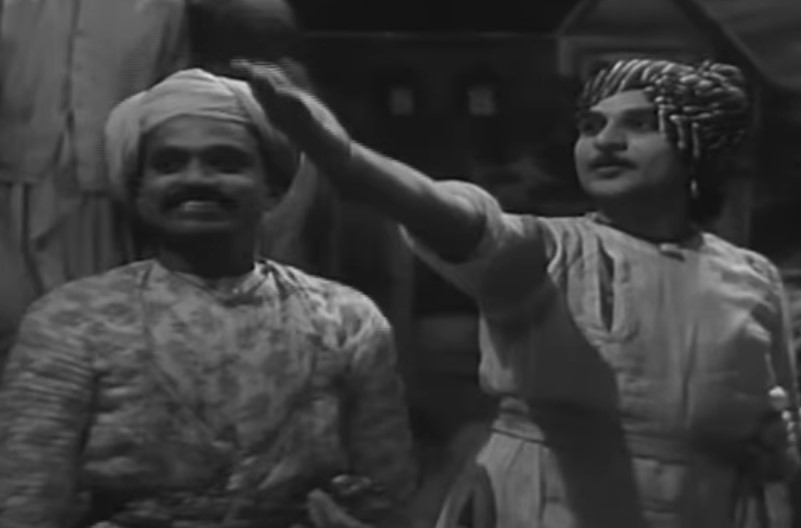
He was thinking of her as a respectable lady but she is a lowly dancer. And top of this, she is singing his songs in public. How can she stoop so low? Gunawati tries to explain but he is no mood to listen. Her mother insults him. Honaji, in a fit of rage, decides to visit all the tamasha performers in Pune and make them sing his poems. He and Bala join forces and perform all over the city and are hugely successful.

Soon, the whole city is indulged in the performances of Honaji and Bala. This makes it easier for the Holkars to execute their plan. Will they be successful? Will Honaji realize what his anger has unleashed and can he remediate the situation? Will Honaji and Gunawati reconcile?

The Music

The music is the clear winner. Honaji’s lyrics are set to tune by Vasant Desai and is easily one of his best works. Each composition is a gem starting with the Bhoopali tuned Ghanshyam sundara. Pandit Rao Nagarkar, Lata Mangeshkar and Asha Bhosle lend their voices to Sanga Mukund kuni haa pahila?, Ghadi ghadi are Manmohana, Tujhya preetiche dukkha mala, Latapat latapat, Nako door deshi jaoo sajana, Tuzi mazi preet, Sundara mhane dilbara, Tu Pak Surat Kamina and Phadakto Bhagwa Zenda.

My Thoughts

The film is a biopic. The inclusion of events covering the historical references of the time and their influence, make it more interesting to watch. The acting can seem theatrical and dialogues a bit old fashioned. The V Shantaram touch is evident throughout the movie. The attention to detail, song picturization, dash of humour in some scenes is satisfying.

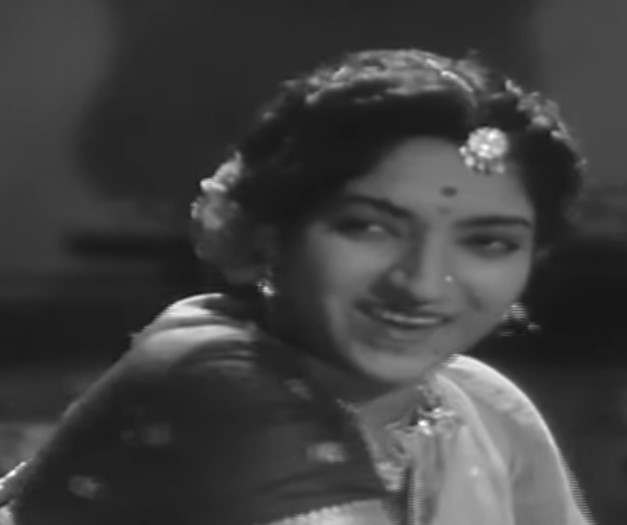
Lalita Pawar is effective in her supporting role. Pandit Rao Nagarkar looks more comfortable singing than acting. This was Sandhya’s debut movie. She is expressive and holds the audiences attention especially in the song sequences.

Mr Natwarlal (1979)

The week gone by saw the birthdays of Amitabh Bachchan (11 October) and Rekha (10 October). One of the most famous pairings of Hindi cinema, they became famous because of their onscreen as well as offscreen chemistry. So much has been written about their professional and personal lives. Undeniably, they were not mere stars but brilliant actors who could shine in the different roles they portrayed. This was a major contributing factor to ensure the film’s success.

From Do Anjaane (1976) to Silsila (1981), they did about 9 movies together including Mr. Natwarlal which will be covered in today’s post. While not a great film, Amitabh’s stardom and the lead pair’s chemistry are perhaps its redeeming factors. And the presence of a tigress, who is a terror on screen and entertainer off it! The film’s title is inspired from an actual con man named Natwarlal.


The Plot

The movie appears in flashback. We hear Amitabh’s voice (we don’t see him yet). He is talking to his son and advising him to be a good boy etc. He tells his son about another young boy called Natwar. Natwar used to live with his brother Inspector Girdharilal (Ajit) and sister in law (played by Indrani Mukherjee). (Ajit was easily 50+ and it is hard to digest he has a school going younger brother!). Girdharilal’s wife is excepting their first child.

Girdharilal is one of those honest and principled police officers. He has been awarded a medal for his distinguished service. He wants Natwar to follow his footsteps and stay away from corruption. Natwar is impressed by his brother’s achievements.

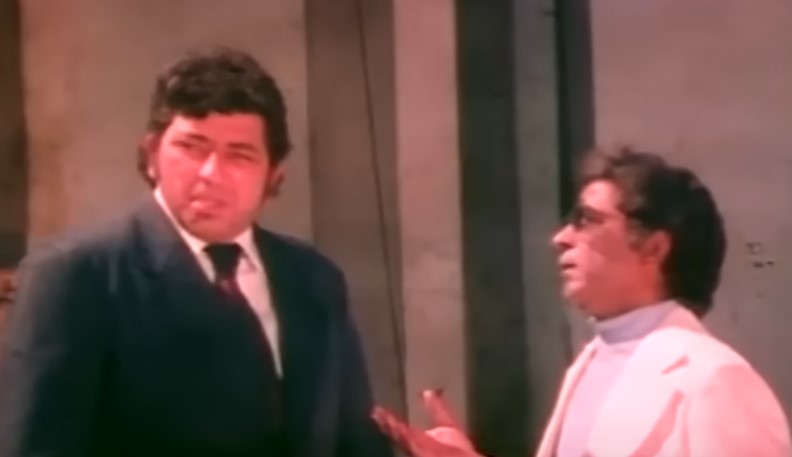
Girdharilal is after Vikram Singh (Amjad Khan) whom he suspects to be engaged in illegal activities. Vikram’s close associate is Mickey (Satyen Kappu).

Vikram knows Girdharilal cannot be bribed and threatens his family (by pouring petrol around his house and leaving a snake in their bedroom) with dire consequences. Later, he plots and frames Girdharilal in a bribery case leading to a CBI investigation. There is a court case and Girdharilal needs some solid evidence to prove his innocence and unmask Vikram as the villain. A frustrated Girdharilal visits Vikram’s factory. Through sheer luck he gets the required proof to nail Vikram.

Vikram retaliates and attempts to crush Girdharilal, his wife and Natwar in a speeding car. They escape but Girdharilal’s wife is seriously injured. The doctor informs she has lost her child and can never conceive. She accepts the reality and consoles Girdharilal by stating Natwar will be their son going forward. Natwar calls her “bhabhi maa.” Vikram and Mickey flee the country and disappear from the scene.

Natwar is affected emotionally by the events and the suffering of his brother and bhabhi maa. He vows to track down Vikram and seek revenge for his deeds. But he knows he has to become a bad man himself to achieve his target. It doesn’t help to be principled and ethical always.

20 years pass and Natwar grows up (played by Amitabh Bachchan). He is a con man “Mr. Natwarlal”, a kind of Robin Hood who robs the rich but also helps needy people. All this with the sole aim to reach Vikram Singh one day. His bhabhi maa is that typical filmy “maa” character who feels her son can do no wrong and trusts him blindly. His brother on the other hand knows the shady dealings that Natwar is involved in but is unable to prove it. Natwar manages to outwit him every time and stay one step ahead of the police.

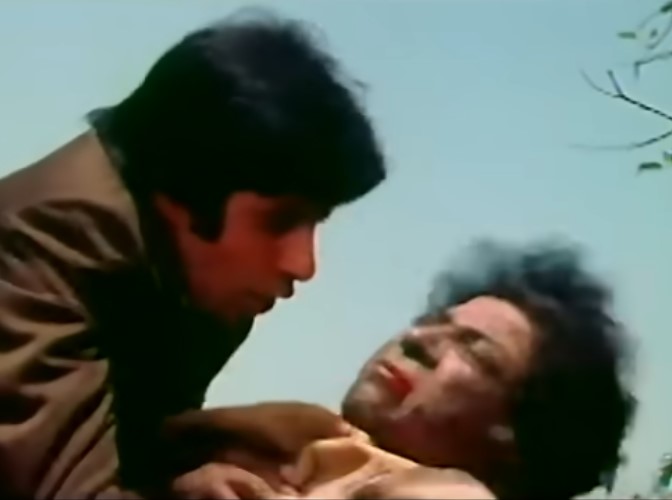
One day, Vikram Singh’s associate Mickey calls Natwar to a secluded place, posing as a thief who got burnt in an explosion. He tells Natwar that he had intended to steal a priceless diamond necklace from Seth Fakirchand (Yunus Parvez) and ensure it reaches the border of Chandanpur by the 10th of the month. But he is unable to do it himself. Natwar has no intention of being part of this plan and prepares to leave. But Mickey plays his trump card by calling out Vikram’s name. Natwar agrees to the proposal as this offers him an opportunity of getting closer to Vikram.

After Natwar leaves, Mickey removes his burnt man’s disguise as Fakirchand comes to meet him. This is all part of a well thought plan. Mickey reveals he was once the right hand man of Vikram but they had a fallout and now he is Vikram’s enemy seeking his downfall. He also reveals that Vikram Vikram is operating some illegal diamond mines near Chandanpur. He has a habit of branding the letter “V” on his servants as a permanent mark to remind them of their allegiance. Mickey intends to kill Vikram (and Natwar) and be the sole possessor of the mines. This way he will extract his revenge.

Through some funny scenes, it is revealed that the necklace has been stolen from Fakirchand’s safe in spite of all the security in place (anybody can guess who the thief is!). So, Natwar in possession of the necklace, starts for Chandanpur.

Chandanpur is set in the lap of the Himalayas close to the border. It is here that Vikram Singh has established his illegal mine cum hideout. He uses a tiger to terrorize the villagers. Under the guise of the tiger attack, he kidnaps the villagers and makes them work in his mines. He literally treats them like slaves.

The villagers are under the assumption that the missing men have been eaten by the tiger (300 men in 2 months, that’s the mind blowing statistic!). Life has become miserable for the villagers. Among the villagers is the chief (Kadar Khan) and Shanno (Rekha). The chief has sent for a hunter Avtaar Singh to help them out. However unknown to them, Vikram nabs him before he can reach the village and kills him.

When Natwar reaches the village, the chief assumes he is Avtaar Singh. Natwar doesn’t understand but acknowledges he is the man they are looking for. The chief updates him on how the tiger has terrorized the area and seeks his help.

Natwar soon gets an opportunity to face the tiger. He pushes some strategically placed drums (which often happens in movies!) along a slope. The drums roll down the slope scaring the tiger away. The villagers are convinced Avtaar Singh is the man who will relieve them of their suffering. Natwar settles down in the village.

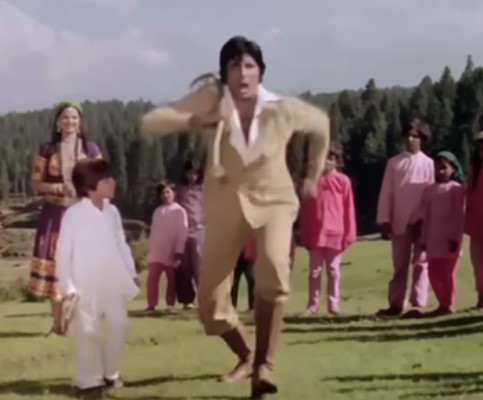
And its time for a bit of lighter moments and romance. Natwar befriends the kids in the village by singing a song Mere paas aao mere doston ek kissa suno. Shanno admits her love for him singing Pardesiyan ye sach hai piya.

News are reaching Vikram Singh about the hunter’s arrival. He knows the man cannot be Avtaar Singh and sends his spies to find the truth. The track continues for some time before Vikram and Natwar come face to face. Natwar manages to escape but he is on track to seek his revenge.

The game of cat and mouse continues before a typical climax. And Natwar does manage to capture the tiger and shrewdly use it against Vikram.

The Music

Rajesh Roshan is the music director with lyrics by Anand Bakshi. Two songs are quite well known one of them being Pardesiyan ye sach hai piya (Lata Mangeshkar and Kishore Kumar). But the unique song is Mere paas aao sung by Amitabh Bachchan. This was his first song as a playback singer and became very successful.

Other songs are also good including Tauba tauba (Asha Bhosle), Qayamat hai (Mohammed Rafi and Anuradha Paudwal) and Oonchi oonchi baaton se (Mohammed Rafi and Usha Mangeshkar).

My Thoughts

The film was released when Amitabh was in his peak form. It makes use of all his skills be it action, romance, comedy and even singing to impress the audience. And his chemistry with Rekha is satisfying. There are many subtle moments between the two and very entertaining to watch. Amjad Khan is his usual best as the villain and Satyen Kappu is impressive. Other actors perform as required. The tigress (Bharati) plays her role convincingly and is an important character throughout the movie!

The film is not without its flaws. There are loopholes in the story and improbabilities. It is difficult to believe someone operating a diamond mine close to the border and the police and Border Security Force (BSF) being unaware of it. The second half drags on as Natwar gets closer to Vikram and extract his revenge. But such things don’t matter when you have a superstar and his immense star power. Its Amitabh all the way for guaranteed box office success!