Escapade in Japan (1957)

Escapade in Japan is a charming story of 2 young boys (one American and one Japanese) who run away from home and spend time traversing across Japan. Escapade means an adventure involving danger. Set in post world war Japan, it was made by RKO Radio Pictures; produced and directed by Arthur Lubin.


The Plot

At the beginning, we see the Manila international airport. A young boy Tony Saunders (Jon Provost) is travelling alone to join his parents in Tokyo. His parents are Dick Saunders (Cameron Mitchell) and Mary Saunders (Teresa Wright). His father has transferred to Tokyo after spending 2 years in Manila. Apparently the real reason of the transfer is marital discord. Dick had got involved with another woman in the Philippines while Mary was in the U.S.. Mary wants to clear up things with her husband before Tony joins them. She is planning to leave Dick and return to the United States with Tony.

Tony is enjoying his flight by reading comics and dozing. The plane develops a mechanical fault suddenly and begins descending. An emergency is declared. The plane is set to make a ditch i.e. an emergency water landing. After that the plane loses contact and it is not clear what whether it crashed, the passengers are safe etc. The U.S. air force has deployed nearby ships to search for the missing plane as its exact location remains known.

Tony’s parents arrive at the airport and come to know about the unexpected development. They go back home and wait impatiently for the plane’s and Tony’s whereabouts. Mary blames herself for leaving him alone in Manila.

But Tony is safe and sound! He is floating in the water on a life raft, wet and hungry but otherwise fine. Its a foggy morning. Tony’s raft is sighted by a young Japanese boy Hiko (Roger Nakagawa). Hiko is on a fishing boat with his father Kei (Susumu Fujita) and mother Michiko (Kuniko Miyake). The family is out fishing in the sea. They bring Tony on board, make him warm and feed him. Luckily, Hiko speaks English and starts conversing with Tony. Both the boys soon become friendly. There is a fun scene when Tony is hungry and “learns” the use of the chopsticks, courtesy Hiko.

After the fishing is done, the family returns to their home in the village. Hiko overhears his father telling his mother that he will inform the police to take Tony away. Hiko misundertsands the intention of calling the police. He tells Tony that the police will take Tony to jail and he will not be able to meet his parents. A worried Tony pleads Hiko to help him. A quick decision is made. Hiko decides to run away with Tony. They start their journey on a tempo loaded with vegetables with the intention to reach Tokyo where Tony’s parents have been stationed.

The village is some 3 hours away from Tokyo. After receiving news from the police and the air force officers, Tony’s parents arrive in the village to find the boys have gone. Tony as well as Hiko’s parents share the same difficult situation and try to pacify each other. They are all trying to comprehend what made the boys leave so suddenly.

The parents wait impatiently for the Japanese police to find the boys. It is night time and the boys are hungry. Hiko interacts with an elderly couple and gets food. Next day, they hop on a goods train. Hiko doesn’t know if the train goes to Tokyo but the intention is to get away from the police. Unfortunately, they are caught and asked to get off the train. They do so to find they have landed in Kyoto which is far off from Tokyo.

Thus begins their Kyoto tour and getting a slice of Japanese city life. They visit a couple of entertainment shows including a Geisha performance. After the show, they are met by a friendly Geisha. Hiko tells her that they are not lost but hungry. She asks them to come with her.

She takes them to the Geisha residence. Here the boys enjoy a luxurious bath and delicious food. Further they are entertained with a baseball themed dance. But Tony being Anerican has attracted attention. Later, Hiko overhears that the police will be called for in the morning and informs Tony. Its time to flee.

Next day in Kyoto, they see a bus full of school children. Apparently, its the children’s day out and they are undertaking the Kyoto city tour. Tony and Hiko join them and spend the day with the students and their teacher. They are enjoying the tour. Unfortunately, Tony’s picture has been published in the newspaper. Hiko shows it to Tony and they run away again. Meanwhile, Tony’s parents have reached Kyoto (the police had been informed by the Geisha). The hyper school teacher meets them and explains the situation.

The boys reach the railway station and manage to get in without tickets. They randomly board a train to Nara. We see the train to Tokyo on the neighbouring platform! The adventure continues leading to an exciting climax and reunion with the parents.

The Music

The music by Max Steiner is impressive and carries the mood of the movie. The Japanese music adds its own charm.

My Thoughts

The film is set in the post world war period when US forces continued their presence in the country. It does not make any political commentary but presents the Japanese in a positive light. In one scene, it is made clear that Japanese boys don’t have a habit of running away, nor do children get kidnapped. This points to the children being safe and taken care of even if they are alone, which is depicted in the movie.

There are some funny interactions between the 2 boys. The English language is hilariously termed as “American” by Hiko. In one scene, Tony is impressed that Hiko is learning English but ponders why he is not being taught Japanese. The boys wonder why cant everyone converse in one language, it would be so easy.

The story is kept simple and the boys do not encounter obstacles in the form of a villain as is commonly shown. The acting is casual. The pace is slow and you get a bit bored in the middle. There are many Japanese dialogues and it would have been interesting if they had subtitles to get a flavour of the conversation. The parents don’t have much to do except worry and wait but provide good support. The show stealer is undoubtedly Japan. Right from the the fishing village to the scenic country side and city shots capture 1950s Japan in its Technicolor splendour. Come and indulge…

Laxmikant Pyarelal – Disguise and Deception Songs

Laxmikant Pyarelal (LP) were a prolific music director duo of Hindi cinema. They saw unprecedented success and continued to work together from the early 1960s till the late 1990s (Laxmikant had passed away on 25th May 1998). While they had their share of critics, it did not affect their whopping output, delivering one hit after the other across various genres. Similar to other music directors, they created their own brand LP, which had an enduring journey.

Hindi films have situations where the actors are involved in deception for various purposes. This may be to commit a crime, to fool someone, save someone and so on. And may involve the use of disguises. Overall, resulting in some entertaining situations for the audience. Today’s post covers such songs involving disguises and deceptions, all from the able hands of LP. Enjoy!


1) Song: Hansta Hua Noorani Chehra
Film: Parasmani (1963)
Credits: Asad Bhopali | Laxmikant Pyarelal | Lata Mangeshkar and Kamal Barot

Lets start with LP’s debut film Parasmani, a B grade fantasy film. With songs like “Woh Jab Yaad Aaye“, “Mere Dil mein halki si“, “Hansta hua“, “Roshan Tumhi se,” it marked the arrival of LP as new music directors. The hero (Mahipal) in search of the parasmani reaches a strange land ruled(?) by a sorceress. He pretends to be in love with her and she believes the deception. She is happy and arranges an entertainment song through her magical powers. Apparently, LP felt this was a weak song compared to the others but this became the most famous song from the movie. Today, Parasmani is synonymous with this song, what say?


2) Song: Pyar Kiye Jaa
Film: Pyar Kiye Jaa (1965)
Credits: Rajendra Krishan | Laxmikant Pyarelal | Kishore Kumar

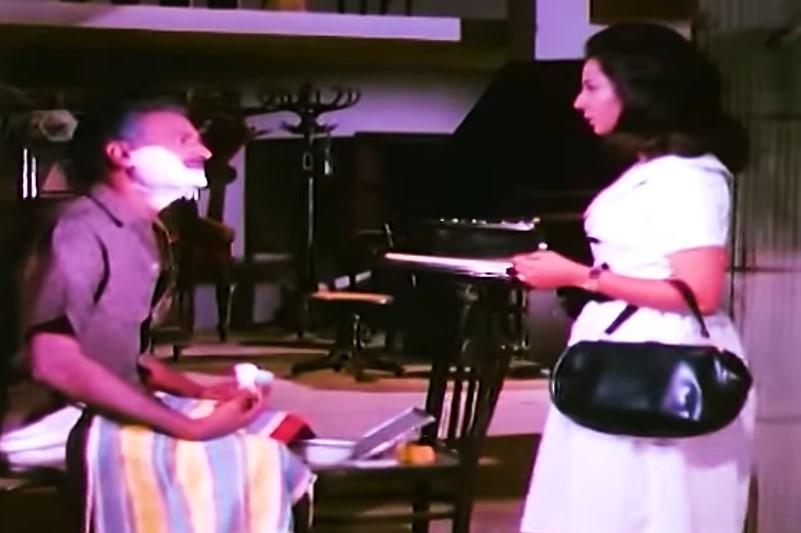
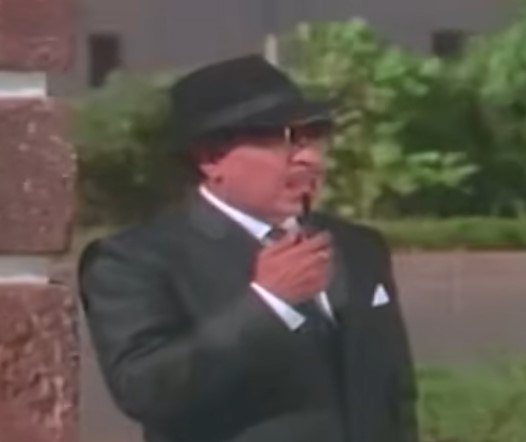
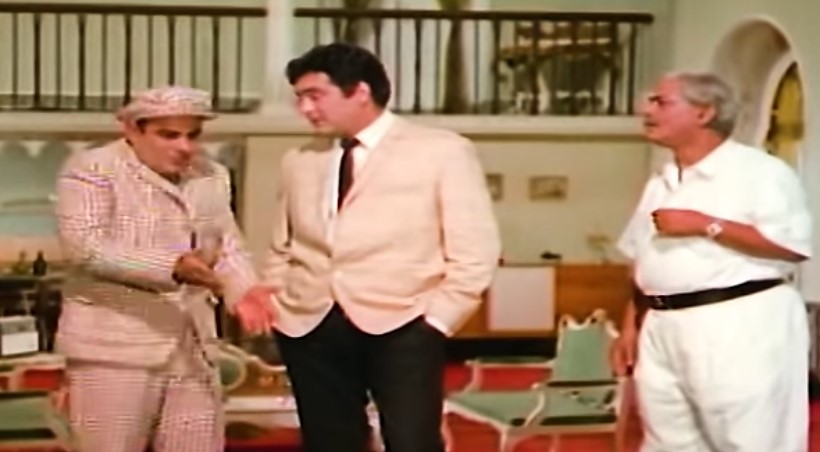
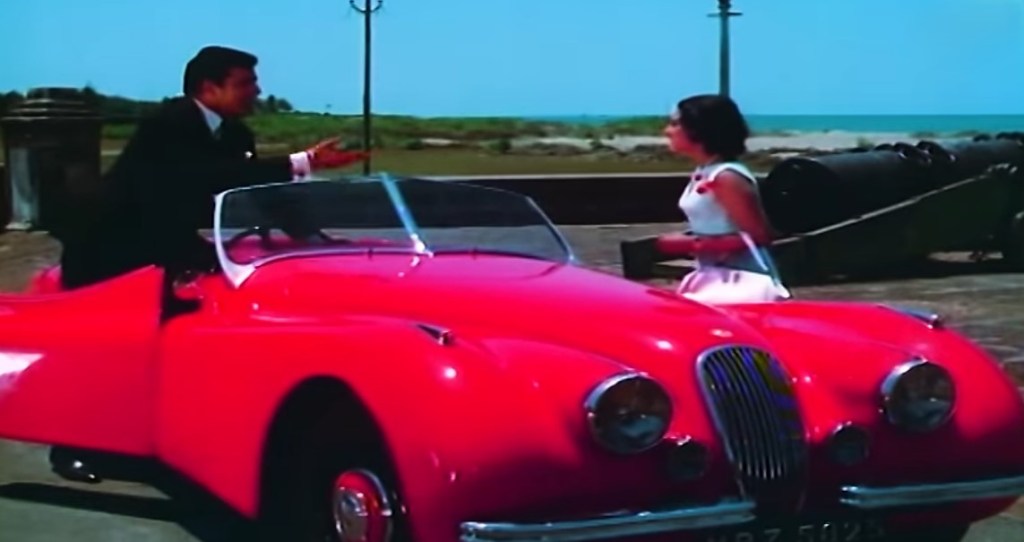
This delightful comedy film was a remake of a Tamil film. Here, we have Kishore Kumar masquerading as an old man for most of the movie. He teases the young heroine (Kalpana) who doesn’t know it’s her boyfriend behind the beard. LP gave some light compositions suiting the mood of the movie. They seem to give a free hand to Kishore Kumar in this song, who as expected excels in the singing and acting.


3) Song: Mera Naam Hai Chameli
Film:  Raja Aur Runk (1968)
Credits: Anand Bakshi | Laxmikant Pyarelal | Lata Mangeshkar

Based on the prince and the pauper plot of lookalikes getting interchanged, the movie had all great songs by LP. This is a situational song. A dancer (Kumkum) hatches a plan to free Sanjeev Kumar from the prison. She assumes the role of a gardener (maalan) and reaches the prison with her basket of flowers. In filmy style, she sings this catchy number, diverts the attention of the prison guards and gets closer to the prisoner. Seems its not very difficult to fool filmy security guards through such deceptions.


4) Song: Geet Tere Saaz Kaa
Film: Intaqam (1969)
Credits: Rajendra Krishan | Laxmikant Pyarelal | Lata Mangeshkar

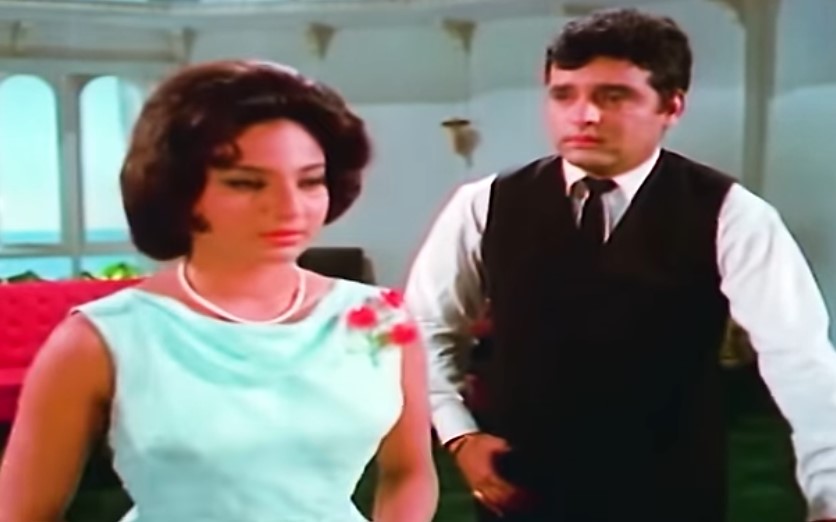
Deception for revenge would be the apt description of this song. Circumstances lead the heroine (Sadhana) to trap the hero (Sanjay Khan) and make him fall in love with her. All this to avenge the wrongdoings of the hero’s villainous father. The beautiful heroine sings the song and the hero enchanted by her voice (and beauty) gets drawn to her. This is a melodious song. Intaqam is better known for the Aa Janeja number, arguably one of few such songs sung by Lata Mangeshkar.


5) Song: Jaipur Ki Choli
Film: Gehri Chaal (1973)
Credits: Rajendra Krishan | Laxmikant Pyarelal | Kishore Kumar and Asha Bhosle

A not so famous movie but had some catchy numbers by LP. Jeetendra and Hema Malini disguise as dancers and visit Bindu’s house to trick her and get some vital information. They perform this folksy number and get closer to their purpose.


6) Song: Amar Akbar Anthony
Film: Amar Akbar Anthony (1977)
Credits: Anand Bakshi | Laxmikant Pyarelal | Kishore Kumar, Mahendra Kapoor and Shailendra Singh

A crazy but one of the most entertaining movies from Manmohan Desai complemented by fun songs from LP. Based on the lost and found formula, the three brothers from different religions reunite (in disguises) in this climax song. Once again, LP gave some evergreen songs and won their fourth Filmfare award for this movie.


7) Song: Hum Banjaaron Ki Baat
Film: Dharam Veer (1977)
Credits: Anand Bakshi | Laxmikant Pyarelal | Kishore Kumar, Lata Mangeshkar and Chorus

Same year, another Manmohan Desai movie. This time a plot of lost and found twins. The songs are a bit weak compared to Amar Akbar Anthony. This is another escape via deception song. Dharmendra is imprisoned by Zeenat Aman. Jeetendra (a prince) gets the help of gypsies (banjaras) to get him freed. He pretends to be a dancer with Neetu Singh and they perform this hit song. This is one of those songs with a grand set and an equally grand musical composition, courtesy LP!


8) Song: Band Aankh Se Dekh Tamasha
Film: Parvarish (1977)
Credits: Majrooh Sultanpuri | Laxmikant Pyarelal | Kishore Kumar, Amit Kumar and Chorus

And one more Manmohan Desai movie with all the masala elements of lost and found, crime, revenge etc. Almost all songs from this movie involve some disguise or deception! Hum premi prem karna jaane and Jaate ho jaane jaana are more famous compared to this song. In this song, Amitabh pretends to be blind. He visits his brother Vinod Khanna who teaches in a blind school. In reality, Vinod is a smuggler. Amitabh joins the blind students on a boat tour. But his purpose is to catch his brother red handed while completing a smuggling operation in the sea. It is fun to note that Vinod Khanna “teaches” a song to the students by playing the tape recorder while he completes his smuggling job in a nearby boat. The things that happen in movies!


9) Song: Hawa Hawai
Film: Mr. India (1987)
Credits: Javed Akhtar | Laxmikant Pyarelal | Kavita Krishnamurty and Chorus

A delightful movie that became a cult classic. And what an iconic composition by LP! A reporter (Sridevi) overhears a conversation involving some villains and a dancer called Hawa Hawai. Being the investigative journalist, she presents herself as Hawa Hawai and performs this weird song.


10) Song: Choli Ke Peeche
Film: Khalnayak (1993)
Credits: Anand Bakshi | Laxmikant Pyarelal | Alka Yagnik, Ila Arun and Chorus

Sanjay Dutt is the Khalnayak. Madhuri Dixit is the policewoman tracking him in order to capture him. And being Madhuri, a dance performance is the best way to try and trap the offender. A controversial song but LP prove they still had it in them to give a chartbuster, 30 years after Parasmani. Indeed, this catchy rhythmic song has become synonymous with the movie. It also got the Filmfare awards for its singers.

Ek Gaon Bara Bhangadi (1968)

The 1960s was a period when Marathi cinema saw a wave of tamasha oriented movies. Sangtye Aika (directed by Anant Mane) was probably the trendsetter of this wave. Tamasha movies make use of the lavani dance form (from the state of Maharashtra). Typically, the story revolves around the lavani dancer character, in a village set up. And of course, propped up by some catchy music compositions. Ek Gaon Bara Bhangadi (literally one village and 12 affairs) belongs to this genre. It was also directed by Anant Mane.


The Plot

The movie begins with a lavani performance. The village chief “sarpanch” Patil (Dada Salvi) and his two associates Jhele Anna (Nilu Phule) and Gavde Anna (Bhalchandra Kulkarni) attend the show of a renowned lavani dancer Phulawati / Phula (Jayshree Gadkar). Phula presents an intoxicating lavani (Ashi mee khidkit rahate ubhi) and the three are impressed. Jhele Anna requests her to sing a westernised lavani. She immediately complies by singing Raya aata rickshaw hou de suru.

After the performance, the trio meet her and offer her supari (invitation) to visit their village “Mauje Thakwadi” on 15 August. Thak means thug. Phula is first scared by the name but they assure her that its a beautiful village and so are its inhabitants. A convinced Phula accepts the invitation.

The trio return to their village Thakwadi. On the outskirts of the village, they are met by a group of men looking like thugs (or bandits). Apparently there have been some dealings between Patil and these people. Patil warns them not to show their faces until they are called for. When the trio enter the village, they are met by a mad man. This seems to be a typical character in old movies, who normally has a back story relevant to the plot and is revealed later!

There is a new (young and beautiful) school teacher in the village. Unfortunately, she is being pestered by the men of the village, who follow her, pass comments, make funny drawings on the school wall and in general be a nuisance. Frustrated, she approaches the sarpanch Patil for help. However on the pretext of being sympathetic, he tries to take advantage of her. His wife arrives suddenly and the teacher manages to flee from the scene.

She then goes to the school principal (Govind Kulkarni) with a transfer application. He is a good man. He advises to rethink her decision and go to the sarpanch for help. She narrates her embarrassing “experience” at the sarpanch’s house and realises she is helpless. Nevertheless, he tries to pacify her when a man called Gopal arrives. Gopal is one of Patil’s men. He taunts the Principal and the teacher and apologises for “disturbing” their private matter. She leaves hurriedly.

The school Principal is also the secretary cum treasurer of the village cooperative society and manages its finances. Gopal has come with a request of Rs 500 from the society. The society chairman (none other than sarpanch Patil) has recommended / approved the request. The Principal refuses to give the money. Then Patil arrives, lectures the Principal and forcibly hands over the money to Gopal. The Principal explains that these are the society’s funds and should be distributed in a justified manner. He cannot keep working on the sarpanch’s recommendations and waste the money. He quotes a few examples to the furious sarpanch. In total Rs 25,000 have been “utilized” for the welfare of the villagers till date. A servant comes to call Patil as his sister Rajakka (Shanta Tambe) is waiting at his house. Patil leaves but he knows the matter is not over.

Rajakka is a widow and Patil is helping her to manage her farm land. But again, her best interests are not on his mind. She accuses him of stealing her rightful claim to the crop yield and threatens to adopt her nephew, so that there will be no further dealing required with Patil. Patil cannot digest this as it will mean a loss of one of his sources of income. Looking for an opportunity, he pushes his sister from the roof and silences her permanently.

Unfortunately for Patil, the Principal witnesses the murder. There is  no option but to silence the witness. Patil kills the Principal the same night. He kidnaps the school teacher and imprisons her in the basement of his house. Word is spread that the Principal ran away with the teacher and had mismanaged the society’s finances. The villages are shocked but have no option but to believe and accept the news.

Thus we come to know the true character of Patil and his cronies. They can go to any extremes to make money and retain authority in the village. Those who oppose them will be dealt with a rough hand.

But all this is about to change. Enter the hero and heroine. The police receive an anonymous letter and an officer Shirke (Arun Sarnaik) is sent to Thakwadi for investigation. At the station, Phula is boarding the train along with Ganpya (Ganpat Patil). As happens in movies, the hero and heroine board the same compartment (conveniently first class). Shirke plays a prank and records the conversation between Phula and Ganpya. He explains he has a tape recorder which is used to record voices, songs etc. This helps to break the ice. He requests Phula to sing a song. She obliges and sings a devotional song “Kashi gavalan Radha bawarli”.

Later in the night, a robber enters the compartment. Being the policeman, Shirke saves Phulawati and she expresses her gratitude. Shirke hatches a plan. He will join Phula’s troupe as a musician so he can enter Thakwadi easily without any suspicion. The plan is carried out. They settle down in the village. There are more lavanis on the way (Ata lagnacha way maza zhala ga and Thawa nahi ishqacha inga).

So we have lots of investigation work by Shirke with support from Phula leading to some interesting developments. Patil is a wily character. He is suspicious about Shirke and his intentions. There is another murder – Jhele Anna is eliminated when he tries to go against Patil. Shirke moves closer to the truth leading to a rather unexpected climax.

The Music

Veterans Jagdish Khebudkar (lyricist) and Ram Kadam (music director) have collaborated in multiple movies and their lavanis are a delight for the audience. It is a difficult task to write the appropriate song for every situation which has to be in a lavani format. And equally difficult to compose a matching tune. For example, the western lavani in this movie which has to sound western but have the structure of a lavani! As expected, they are successful in their task.

Krishna Kalle has sung most of the songs, while one by Suman Kalyanpur and one by Balakram. The standout song is the title song (Ek gaav an bara bhangadi aika sangte kahani ) where all the wrongdoings are revealed in a lavani performance much to the shock of the villagers.

My Thoughts

The storyline is predictable as we know the villain and the outcome. But the director’s treatment makes it an interesting watch with the help of good songs. Arun Sarnaik and Jayshree Gadkar share good chemistry. Thankfully, there is no long drawn romantic plot with unnecessary songs. The heroine excels in the acting and the dance performances. Dada Salvi is a bit monotonous as the villainous sarpanch who has only one mission – his own welfare. But he enacts the evil character convincingly. This was Nilu Phule’s debut movie. Strangely his Jhele Anna character talks in a Belgavi accent instead of his trademark voice that achieved legendary status. The actor playing Gopal is impressive.

Overall, a predictable affair which is worth a watch.