Lata Mangeshkar – Birthday Songs

Today is 28th September, and we are remembering Lata Mangeshkar on her birthday. But remembering would be a wrong word as I am sure there is hardly a day when we don’t hear her songs. It might be from the classic era – 50s and 60s or the 90s where she sang selectively but continued to deliver huge hits. It might be a film song or otherwise. As often repeated, there will be no one like Lataji again. Such is her influence.

Thinking about a theme is so difficult when it comes to such a great artist. I had written about 1 voice and 10 heroines earlier remembering the singer and some of the heroines she sang for. Today’s post is about birthday songs sang by Lataji. Birthdays are common situations in our movies and a perfect reason to place a song. While meant to be a cheerful occasion, we see the occasional twist, adding to the entertainment.


1) Song: Da Dir Daara…Meri Laadli
Film: Andaz (1949)
Credits: Majrooh Sultanpuri | Naushad | Lata Mangeshkar and Chorus

Starting with one of the very early songs of Lataji. This was her first collaboration with Naushad, with whom she had a long association till the 1990s. In the song, Raj Kapoor and Nargis are celebrating their daughter’s first birthday. Everything is fine till Dilip Kumar’s arrival which adds drama to the scene. Nargis pauses when she sees him but gains control and continues the song. Lataji’s voice sounded young but it had the range and throw that were going to become legendary soon.


2) Song: Ek Bewafa Se Pyaar Kiya
Film: Awara (1951)
Credits: Hasrat Jaipuri | Shankar Jaikishan | Lata Mangeshkar

Similar to Naushad, Lataji had a long association with Shankar Jaikishan, who gave her some of the best songs of her career. Not to forget Raj Kapoor’s legendary banner R.K. Films under which this film was made. In this scene, it is Nargis’s birthday and meant to be a happy occasion. But there is a twist before the song which reveals the harsh reality of her lover (Raj Kapoor). Her friend sings the song but it is a reflection of her troubled state of mind. What to say about Lataji’s singing – effortless and amazing breath control.


3) Song: Pawan Diwani
Film: Dr Vidya (1962)
Credits: Majrooh Sultanpuri | S. D. Burman | Lata Mangeshkar

It is Vyjayanti Mala’s onscreen birthday party. And her dance performance is the return gift for the assembled guests! Her performance is impeccable but Lataji’s divine singing displays her classical singing prowess. Definitely one of those songs which are a treat to the eyes and the ears in equal measure.


4) Song: Tumhe Aur Kya Doon Main
Film: Ayee Milan Ki Bela (1964)
Credits: Hasrat Jaipuri | Shankar Jaikishan | Lata Mangeshkar

Shankar Jaikishan once again, with their favourite Raag Bhairavi. And Lataji’s voice blending with Saira Banu’s screen presence takes it to another level. A melodious song celebrating the birthday of the 2 heroes – Rajendra Kumar and Dharmendra. She is wishing both of them but her heart is set on one of them!


5) Song: Kya Rang-e-Mehfil
Film: Dil Diya Dard Liya (1966)
Credits: Shakeel Badayuni | Naushad | Lata Mangeshkar and Chorus

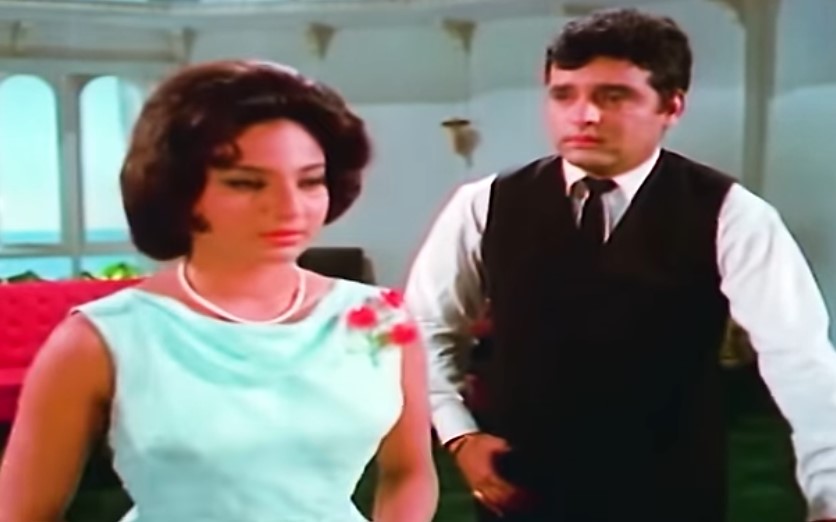
A messy and forgettable film with great music. A different composition from Naushad and presented so brilliantly by Lataji. It is Shyama’s birthday celebration. Waheeda Rehman is requested or rather forced to showcase her singing skills in the party. She obliges by singing this enchanting number.


6) Song: Dulhan Ban Ke Aayi Umango Ki Shaam
Film: Saaz Aur Awaaz (1966)
Credits: Khumar Barabankvi | Naushad | Lata Mangeshkar

Another Naushad composition from another forgettable film from the 60s. But the songs were good like this number based on Raag Pilu. This time it is Saira Banu’s birthday. She arrives late and performs this song, thanking the guests and well wishers who have come to greet her. It has the Naushad stamp and Lataji delivers the intricate number convincingly.


7) Song: Aaj Hai 2 October Ka Din
Film: Parivaar (1967)
Credits: Gulshan Bawra | Kalyanji Anandji | Lata Mangeshkar and Chorus

Jeetendra and Nanda are celebrating their son’s birthday. What is special is it is 2nd of October which is the birthday of 2 great leaders – Mahatma Gandhi and Lal Bahadur Shastri. The lyrics describe both the personalities and wish the child to try and follow their paths.


8) Song: Badhai Ho Badhai
Film: Mere Munna (1967)
Credits: Qamar Jalalabadi | Kalyanji Anandji | Lata Mangeshkar

And finally a song sung by a child! Junior Mehmood sings the song with playback by Lataji. Seems it is Nutan and Rehman’s son’s birthday and Jr. Mehmood is wishing him by singing this delightful song. One of Lataji’s ability was to sound like the character she is singing for and does so here as well. Singing for a child and that too a boy with desirable results!


9) Song: Janam Din Aaya
Film: Baharon Ki Manzil (1968)
Credits: Majrooh Sultanpuri | Lamikant Pyarelal | Lata Mangeshkar and Chorus

This was a film with a different story line. Meena Kumari plays the role of a woman who has lost her memory for many years. This song celebrates the birthday of her daughter (from a small child to a grown up girl (played by Farida Jalal)). Lataji sang the most number of songs for the Laxmikant Pyarelal duo over more than 3 decades of their luminous career.


10) Song: Choron Ko Saare Nazar Aate Hai Chor
Film: Naya Zamana (1971)
Credits: Anand Bakshi | S. D. Burman | Lata Mangeshkar

And the final song in today’s list – not a happy song by any means. This is a situational song as per the demand of the movie. It is Hema Malini’s niece’s birthday. She has invited her “poor” friend Aruna Irani for the party. Aruna gets wrongly accused of stealing by Hema’s sister in law (Indrani Mukherjee) because she is not wealthy like the other guests. She is hurt by this behaviour but she doesn’t leave as she has promised to sing a song on this joyous occasion. She stays and entertains the affluent guests by singing this song sarcasm filled composition. Lataji brings out the emotions effectively – part hurt and part angry.

Jai Santoshi Maa (1975)

The year 1975 was a historical year for Hindi Cinema. This was the year that saw the release of Sholay which became a milestone for Indian cinema. Apart from Sholay, there were a host of movies from big banners, bigger stars and directors like Deewar, Dharmatma, Pratigya, Sanyasi, Khel Khel Mein, Chupke Chupke, Mili, Warrant and Amanush to name a few. But one film that stood out among all was Jai Santoshi Maa. In the era of the angry young man and changing values (?), this low budget mythological film caught the audience’s imagination and set the box office on fire. Its been 50 years since its release. So, I felt it was time to visit this movie and see what the fuss is about!


The Plot

Jai Santoshi Maa begins with a scene depicting Raksha Bandhan of the gods. Mansa is tying rakhi to her brother Lord Ganesha. His children request her to tie a rakhi but she refuses as she is not their sister. The children run to their father Lord Ganesha and wish (or demand) that he “arrange” a sister for them. His wives Riddhi and Siddhi are supportive of the demand.

Devarishi Narad (Mahipal) arrives and hears the conversation cum request. Narad also requests Ganesha to fulfil his sons’ wish. Lord Ganesha obliges and we see the arrival of his daughter or “Manaskanya”. She is named Santoshi Mata by Narad as someone who will bring happiness and satisfaction in one’s life.

The attention shifts from heaven to earth in Sonepur with the title song Main to aarti utaru re. The heroine Satyavati (Kanan Kaushal) is singing in the temple. She has only one wish from the goddess – a loving husband. Her father is Bharat Bhushan. His only wish is to get her married and be relieved of his responsibility.

While returning from the temple, her friends tease her about marriage. She runs and collides with a young man Birju/ Brij Ram (Ashish Kumar). Satyavati and Birju look at each other and there is an instant connect.

She leaves and he is left in thought. Birju is a singer from the neighbouring town of Mirpur. He roams all day, immersed in music. He is part of a big joint family. His mother is played by Leela Mishra. He has 6 brothers, the eldest being Daya Ram (Manher Desai), followed by Bhairav Ram (Rajan Haksar). All brothers are married. Their respective wives (played by Bela Bose and Asha Potdar) are not happy with Birju. He does not contribute anything while his brothers slog in the fields whole day.

Birju arrives in Sonepur for a festival. Satyavati recognises him as the same person she had collided with. She has not forgotten him. The priest welcomes him and requests him to sing a song in appreciation of Santoshi Maa. He sings Yahan wahan jahan tahan mat pucho kahan kahan hai Santoshi Maa describing that the goddess is everywhere.

After the song, Satyavati is pushed by her friends to compliment him but she mutters some appreciative words and runs away shyly. Outside, she is met by Banke (a dacoit), who tries to molest her. She shouts for help and Birju comes to her aid.

Banke and his band of dacoits are beaten by Birju. Satyavati is relieved and thanks him for his timely intervention. She notices he has got injured and brings him home. Her father is thankful to Birju. He enquires about Birju’s family.

Later, as he is leaving, Birju admits his love for Satyavati. Satyavati goes to the temple and prays to Santoshi Mata to fulfil her wish of getting married to Birju. If this happens, she will visit all temples of Santoshi Mata in different locations.

The match gets fixed, followed by marriage. The baraat arrives at Birju’s house. Satyavati’s sisters in law (bhabhis) have ensured that she will not feel welcome right from the start. After a couple of scripted “inauspicious” happenings, they taunt her by talking about her poverty. Satyavati is disturbed but Birju calms her down.

Birju’s mother tells his brothers to start taking him to the fields. Next day, a reluctant Birju does so. In a random moment, he runs away and comes to meet Satyavati. He says she had called him which is not the case! The eldest brother Daya Ram is amused by the behaviour of the newly weds but Bhairav Ram is not. Nor are their wives.

Satyvati tells Birju of her promise to Santoshi Mata. Accordingly, they go on a pilgrimage and visit her temples in multiple locations (considering the budget of the movie it is clear that the lead pair do not visit all the temples, most of their shots are shot in a studio and the editing “attempts” to make it look otherwise!)

Now is the time to introduce a twist as the newly weds cannot be allowed to remain happy. Devarishi Narad goes to meet the 3 goddesses Laxmi (Neelam), Parvati (Lata Arora) and Brahmani (Padma Rani). He tells them that the people on earth are singing praise of the goddess Santoshi Mata. They are miffed at hearing this. He further quotes the example of Satyavati, who is a param bhakta of only one goddess – Santoshi Mata. They are further annoyed when their husbands (Vishnu, Mahesh and Brahma) disguise as sadhus and visit Satyvati. Her bhabhis insult the sadhus but Satyavati offers them prasad in the form of gud and chana, and displays her devotion. It is time for the 3 goddesses to spice up the proceedings.

Satyavati notices that her husband is being fed leftovers by his bhabhis. Birju is incensed when he comes to know this. There is a strong altercation between the brothers. (Daya Ram is not at home). Bhairav Ram and the younger brothers insult Birju, calling him useless “(nikamma).” Birju decides to leave the house. He vows he will return only after he becomes a rich man and not live at the mercy of his brothers. He tells Satyavati to await his return and leaves abruptly. He starts his journey by getting on a boat.

Thanks to the conspiring goddesses, there is a storm and the boat capsizes. This time, the goddesses arrive in disguise in Birju’s house and inform that he got thrown off the boat and drowned. Birju’s mother and Dayaram are devastated to hear this. Satyavati refuses to accept he is dead. And indeed, Birju is alive. He was about to drown but Santoshi Maa saves him in time.

Birju is looking for means to earn money. He comes in contact with a rich man (jeweller) by helping him when he faints near a temple. The man employs him. Birju is a hard worker and impresses his employer. Again, due to the goddesses, he falls for the man’s daughter Geeta (Rajni Bala) and forgets about Satyavati and his family.

Satyavati’s hardships continue. The bhabhis treat her like a servant and give her hell. Satyavati’s father comes to meet her and take her with him. But she refuses, as she believes her husband is alive and will return one day. She attempts suicide but Narad saves her. He asks her to perform the Sola Shukrawar vrat and pray to Santoshi Mata.

Where will this lead to? Will Birju remember Satyavati? Will they reunite? And what is Santoshi Maa’s role when her devotees are suffering without losing their devotion?

The Music

The songs did well. Kavi Pradeep was the lyricist and C Arjun the music director. The female songs were sung by Usha Mangeshkar. The title song Main to aarti utaru re appears twice and has become one of the staple songs for Dandiya nights during the Navratri festival. The lyrics are simple and tune catchy. Then we have Karti hu tumhara vrat main sweekar karo maa and Madad karo Santoshi mata.

Yahan wahan jahan tahan also appears twice, once in Mahendra Kapoor’s voice and later by Pradeep. Manna Dey sings the sad song Mat ro aaj Radhike.

My Thoughts

The story unfolds in a predictable format. The reason why the goddesses keep testing Satyavati is not convincing. The film seems like a family drama or soap opera. It is a stretch to watch with things getting repetitive. The evil sisters in law are at their manipulative best and irritating. Same for Narad and the goddesses track. The colors are garish and the sets evidently low budget. Such mythological films would typically have some “miracle” scenes requiring special effects which are fun to watch. But here you hardly see such scenes, making it less engaging.

Anita Guha plays the role of Santoshi Maa. She doesn’t have much to do except getting angry and helping the characters when they are in need. The main leads Ashish Kumar and Kanan Kaushal look older for their roles. Ashish Kumar reminds you of a combination of Bharat Bhushan and Biswajeet. Rest of the supporting cast perform as required.

That brings me back to the question – what made the film click ? Was it mere devotion? Or was it a bit of a welcome change to see a different movie in the era of the angry young man? Or was it pure luck?

Whatever be the reason, the film created box office history. Unfortunately, the film’s producer Satram Rohra could not repeat the magic with later films like Nawab Sahib.

Valu (2008)

Valu (The Wild Bull) is a delightful Marathi film. Presented by debutant director Umesh Kulkarni, it shows the simple yet entertaining events in a small village in Maharashtra. It is interesting to watch how the wild bull’s behaviour and the arrival of the forest officer has an impact on the ordinary villagers. The film was successful and has achieved cult status over the years.


The Plot

Valu’s story is set in a village called Kusavde. Swanand Gaddamwar (Atul Kulkarni), a Government forest officer is suddenly requested by his boss to visit Kusavde village to deal with Valu or the wild bull that is causing trouble in the village. Swanand has other pressing matters to attend to (he has a hearing in an important case the next day), and the wild bull doesn’t come under the wild animals category that is his remit. He tries to argue but to no effect. He needs to attend to Valu himself. His staff member Jagnade (Ashok Kulkarni) will accompany him.

That night, he has an argument with his wife (Poornima Ganu) on this matter. He is a forest officer who captures leopards and bisons, and is absolutely not pleased. His younger brother Sameer (Vrushasen Dabholkar) offers to come with him. He wants to shoot a documentary of some thrilling experience. Swanand retorts that all he will be doing is hitting the dart on the wild bull, capture him and return. What’s thrilling in that? But he agrees. So Swanand, Sameer and Jagnade head for Kusavde.

The first person they meet on the way is Jeevan Chowdhury (Girish Kulkarni, sent to receive them by the village chief (sarpanch). On arriving in Kusavde, Swanand is heartily welcomed by the sarpanch Anna (Dr. Mohan Agashe). His wife is Bharati Achrekar. The villagers have gathered in Anna’s house. Anna begins to tell about the village’s colourful history etc but his wife gestures to Jeevan, who skillfully diverts the subject. Swanand asks about Valu. It has been 6 months since the problem started. Initially, the villagers tried to control the animal but were not successful. Swanand asks him not to worry. He will soon capture the “on the run” animal and relieve them of the problem.

Jeevan takes the trio to their accommodation and ensures they are well settled. Sameer tells him that he will need to interview as many villagers as he can for his documentary. Jeevan ensures the news of the documentary shoot is spread all over the village. All villagers are instructed to gather at the village temple. But hardly anyone knows the meaning of “documentary”. For them it’s an opportunity to be part of a film shooting.

Swanand and Sameer soon find that filming the villagers is a daunting task. They are more interested to talk about the village’s problems rather than talk about Valu (they refer to Valu as “Durkya”). Swanand is frustrated as he needs to intervene multiple times to get them on track and talk only about the animal. And it needs a lot of sifting through the details to get a picture of Valu.

Swanand comes to know that Valu / Durkya is considered a holy animal. He would roam freely in the village. Children would play around him, the women would feed him. Overall, he was part of the family for the village. He was welcome everywhere. But one day things changed. He was no longer the gentle giant. He started causing trouble into the lives of the villagers. Valu would eat crops, damage the fields and other property. He injured a few people. One day, someone tries to poison Valu but the food is inadvertently eaten by another bull who dies. Apparently, Valu is also the cause of death of an old and revered man Aaja (Chandrakant Gokhale).

Swanand tries to sketch a daily schedule of Valu. What are his favorite spots, when does he eat, graze and so on. During the course of the filming, not only Valu’s character but the nature and motives of the villagers are also revealed.

Not to forget the egos of the so called prominent people of the village. The sarpanch Anna refuses to come for the shooting. It is a matter of his standing and prestige of his position. The documentary should come to him rather than the other way round. And Jeevan is ever ready to massage his inflated ego! On the opposite side is Aaba (Nandu Madhav), who is Anna’s challenger with his set of sidekicks. He wants to be successful in politics and move ahead. This becomes a game of one-upmanship at every opportunity. Like Anna, Aaba also refuses to attend the documentary shoot. He sends his wife (Renuka Daftardar) and son instead. He knows that Anna had sent for the forest officer. He has plans to catch the Valu single-handedly in an effort to downplay Anna and his efforts.

There is a romantic couple Sangi (Amruta Subhash) and Shiva (Mangesh Satpute). Their fathers are against the match but they do not care and are ready to elope and get married.

Jeevan’s mother is Sakhubai (Jyoti Subhash) who cares for Valu. She feeds him everyday and hopes he will be left to enjoy his freedom. She appears to be a practical woman who has her eyes and ears open and doesn’t shy away from voicing her opinions.

And then we have the village priest (Dilip Prabhavalkar) and his wife (Nirmiti Swant), with their own motives. They would like to maintain equal relations with Anna and Aaba, so that their position is not impacted.

So, this is the overall set up. After gaining all the information, it is for Swanand to get into action and achieve his mission. Will he be successful, will Valu oblige?

The Music

There are no songs but the music by Mangesh Dhakde suits the mood of the proceedings.

My Thoughts

Valu is not the regular movie with a hero, heroine and villain. It is also not a typical comedy film with laugh out loud dialogues. But it is still impactful as a satire on the day to day happenings in the life of the villagers. It also questions whether Valu the animal is to be blamed for all the wrongdoings or the attitude of the humans also needs to be investigated?

The interaction between the villagers is natural and has touches of light comedy in the dialogues. Each person has his own motive and the arrival of a Government employee causes a bit of disruption. They look at it as an opportunity to share their daily concerns with the Government, hoping for a resolution.

Umesh Kulkarni ( as the co-producer and writer with Girish Kulkarni) is successful in delivering a cohesive plot in spite of the multiple characters. An FTII alumnus, this was his first feature film as a director. The talented cast contributes adequately. From the veteran actors to the younger cast, they bring out the colour of their respective characters to full effect. Some of them were not so famous names back then, but the spark is visible. The Valu played by Raja is memorable in the few scenes that he appears in. Hope he was cooperative during the shoot!

Sometimes, an unconventional film manages to catch attention and Valu is one of such efforts.