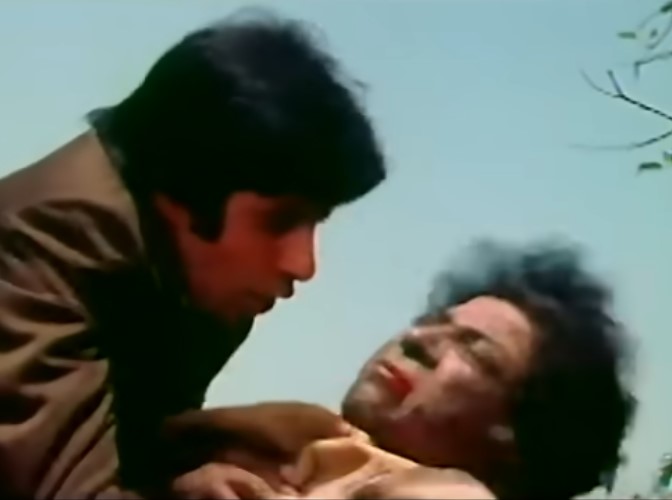
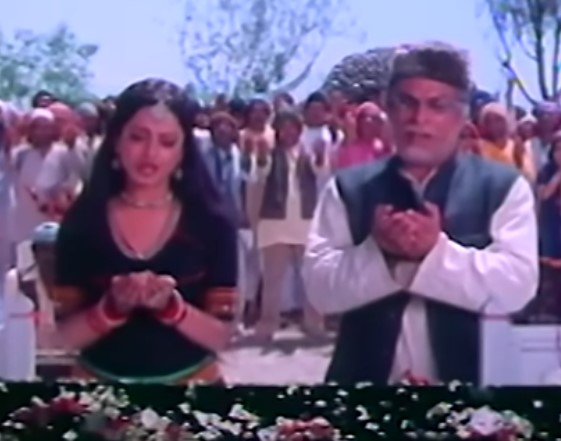
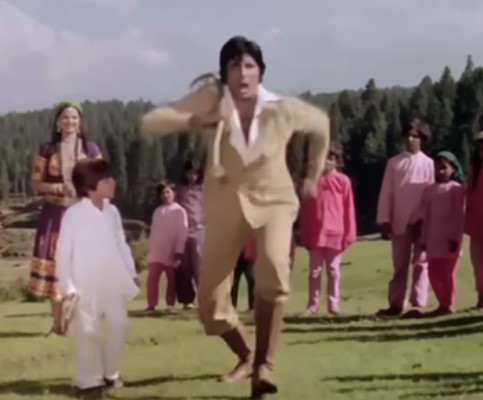
Naram Garam (1981)

In 1979, Hrishikesh Mukherjee presented Golmaal. A delightful comedy, the story was about a boss Bhavani Shankar (Utpal Dutt) and his employee Ram Prasad (Amol Palekar). The boss is a quirky character with his list of do’s and dont’s and his employee has to go to great lengths to keep him happy; all for the sake of his job. Hrishikesh Mukherjee borrows the same theme in his next offering Naram Garam. The film is quite entertaining but surprisingly was not successful as Golmaal.

Utpal Dutt’s death anniversary falls on 19 August, so this post is a way of remembering the great actor.


The Plot

Naram Garam begins with Ram Prasad (Amol Palekar) visiting his village. Vishnu Prasad known as Masterji (A.K. Hangal) has written to him to come urgently. Apparently, their families were quite close to each other when Ram Prasad’s family lived in the village. Later, Ram Prasad sold everything and left the village for better prospects. Masterji welcomes Ram Prasad and updates him about his sorry state of affairs (read financial troubles). Masterji has been borrowing money from the moneylender. He had to mortgage his house when his wife was unwell (who passed away later). He is unable to repay the money and will have to vacate the house in the near future. It seems he does not have any assured source of income.

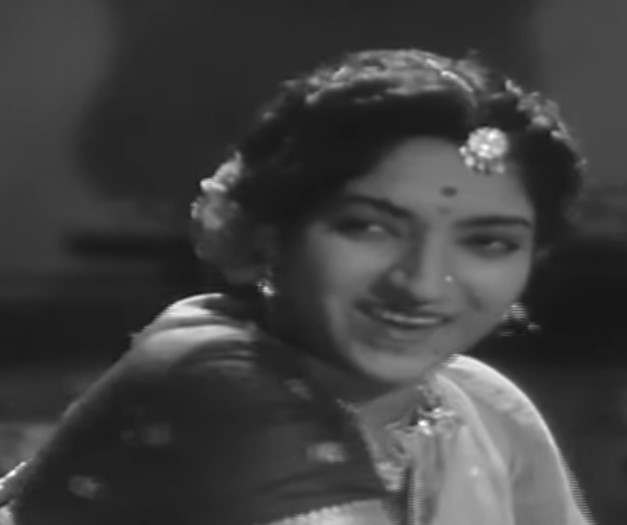
Masterji has a daughter – the beautiful Kusum (Swaroop Sampat). Kusum or Kusi is an educated girl, intelligent and has learnt music. She is of marriageable age but he is in no position to pay the required dowry. This is his second worry.

His final worry is his son Birjoo (Anand) who has joined a drama company. He considers Birjoo a good for nothing son who is not able to support his family in their time of need. With all this background, he requests Ram Prasad to marry Kusum and take her with him. But Ram Prasad politely refuses. He works for a paltry Rs 140 and his own condition is pathetic. He apologizes but he really cannot fulfil Masterji’s wishes.

As expected, Ram Prasad and Kusum share romantic feelings but unfortunately marriage looks a distant dream for them. That night Birjoo comes to meet Kusum secretly. He tells her how much he cares for them. He will be successful in his work and make his father proud. Kusum requests him to come back soon but he says acting is his future. He cannot stay for long. He works in a drama company (owner played by Nilu Phule) and the company is scheduled to depart for its next destination soon. Next day, Ram Prasad leaves too.

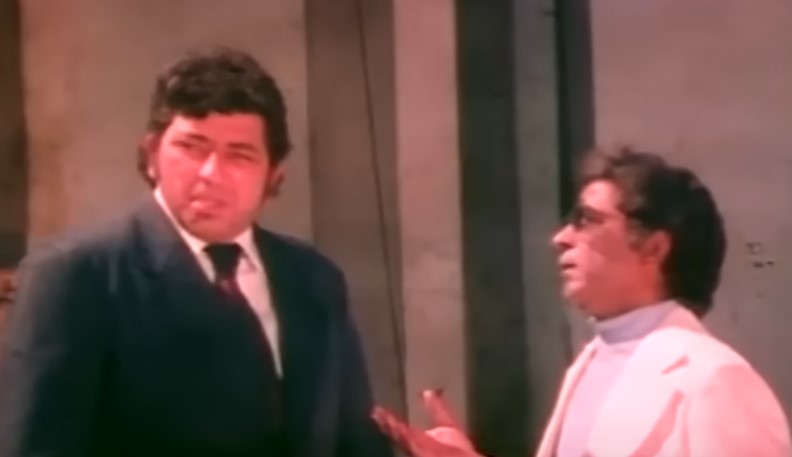
Thus we know the situation of Ram Prasad and Kusum. It’s time to meet Ram Prasad’s boss. The terror called Bhavani Shankar Bajpai (Utpal Dutt). Bhavani Shankar is a miser and highly superstitious man. His wife Ahilya had passed away 12 years back. Since then he spends a lot of time chasing holy men and blindly follow their advice (read superstitions). For example, he will avoid stepping out if there is rahu kaalam (a specific period of time each day considered inauspicious) and expect others to follow the same. This behaviour irritates his employees as well as his family members. His weakness in nariyal ki mithai (sweet made from coconut).

His younger brother is Kali Shankar alias Babua (Shatrughan Sinha). He owns a garage and is happy in the company of his cars and their repairing. He hates tea and prefers chana-gud. He worships women with a strong character such as Rani Padmini, Jhansi ki Rani etc. He expects his would be wife to be of the same calibre. He would rather remain a bachelor than marry a “weak” girl. Unfortunately, Babua’s elder brother has fixed his marriage, much to his displeasure.

Bhavani Shankar has a 16 year old daughter Sumitra alias Sumi (Kiran Vairale). Sumi stays with her maternal grandmother Naniji (played by Dina Pathak). She has to stay there until her father’s so called inauspicious phase passes on in a few months. Naniji does not approve of Bhavani Shankar’s over reliance on astrologer advice and wants him to think practically.

Sumi has come to visit her father, accompanied by her grandmother. Sumi shares a special bond with her uncle Babua and teases him on his would be wife. They sing a song Ek baat suni hai chachaji batlaane waali hai.

Bhavani Shankar has another brother (a distant relative) called Gajanan (Suresh Chatwal) who works as his estate manager. Bhavani Shankar does not consider Gajanan an efficient employee and reprimands him frequently. On the other hand, he is impressed by Ram Prasad, who apparently understands his inclination for superstitions and follows his instructions precisely.

He has assigned a task to Ram Prasad. The Bajpai family owns a property called Bagicha wali kothi in Allahabad. There was an ownership dispute and the court case has been ongoing for 53 years. Bhavani Shankar’s grandfather had filed the case. The property is worth 2 lakh rupees, and his family have spent more than 4 lakhs to fight the case. This will be the last hearing and he is deputing Ramprasad to go to Allahabad. Ram Prasad has to meet with the current lawyer (the seventh, the earlier six have died defending the case!), attend the hearing and come back with the result.

Bhavani Shankar had gone to Banaras to seek his astrologer’s advice on the hearing. He has been advised that the lawyer’s name should start with the letter “R”, the hearing should not happen before 2.30 p.m. and so on. Bhavani Shankar is aghast to hear that the lawyer’s name is Narayan Pandey. However Ram Prasad cooks up a story that his actual name is Raj Narayan Pandey and the first name had to be dropped for some reason. Bhavani Shankar is relieved to hear this. Ram Prasad reaches Allahabad and luckily the court rules in the Bajpai family’s favour.

Bhavani Shankar is overjoyed to hear the news. He gives an increment of “5 rupees” to Ram Prasad for his hard work. Ram Prasad was hoping for a higher rise as he hasn’t forgotten Kusum and the marriage proposal.

Bhavani Shankar asks Ram Prasad to repair and set up the Bagicha wali kothi, so he can stay there occasionally. Ram Prasad completes the job and Bhavani Shankar is impressed. But tragedy strikes for Masterji and in turn Ram Prasad. Masterji has to give up his house as he was unable to pay back the loan. Left with no choice, he comes and occupies the kothi without any prior intimation to Ram Prasad. Ram Prasad doesn’t know how to react to this development. On one hand he would like to help Masterji but he is only a servant, answerable to Bhavani Shankar. If Bhavani Shankar comes to know, it will be a disaster.

But the secret is soon out. News about the illegal occupation of the kothi by an old man and his daughter reach the manager Gajanan and he personally goes to investigate. He confronts Masterji who tells him their sorry tale. However Kusum’s entry and her beauty melts Gajanan’s heart. He voices his thoughts of getting married to Kusum. Masterji can continue to occupy the kothi. Ram Prasad is not amused and escalates the matter to Babua, who confronts Gajanan. Gajanan is shown his place and Ram Prasad is relieved.

However things take an unexpected turn when Babua goes to meet Masterji with the intention of throwing him out of the house and ending the matter. He tries to tackle Masterji physically but an angry Kusum steps in and lectures him about his wild behaviour. Her demeanour impresses Babua. She is the strong character he was hoping to meet some day. She would be the perfect wife for him. To Ram Prasad’s disappointment, Babua softens up and voices his feelings about Kusum. Realising his plan has again failed, he needs to highlight the matter to the elder brother Bhavani Shankar for his intervention.

Bhavani Shankar has been visiting his astrologer Shastriji (Om Prakash in a special appearance). Shastriji has advised him to marry again to settle all his (so called) problems. Once he is married, all the stars and planets will be perfectly aligned and end his worries. (This is a plan of Shastriji. He has another client who has an unmarried daughter called Kalyani. He plans to get her married to Bhavani Shankar.) Shastriji informs Bhavani Shankar that the girl’s name should start with “K.”

Ram Prasad informs Bhavani Shankar about the situation of the kothi and Babua’s intention to marry the daughter of the illegal occupier of the kothi. Bhavani Shankar is furious to hear this. He takes his rifle and goes to meet Masterji.

Meanwhile, Ram Prasad has made plans with Masterji and Kusum to ensure Bhavani Shankar is suitably impressed by their behaviour and the matter will be settled amicably. He even arranges his boss’s favourite nariyal ki mithai, which can be served to pacify him further. Just before his arrival, he gets Kusum to sing a song Mere angana aaye hai Ghanshyam and Bhavani Shankar is impressed by her sweet voice. Bhavani Shankar meets Masterji. When Kusum arrives and serves his favourite mithai, he is taken in by the sweet as well as her looks. He is further convinced when he hears her name. Seems his astrologer was right. There is nothing wrong in considering marriage when someone like Kusum can be the perfect choice for wife number 2. Who cares of the difference in their ages.

Bhavani Shankar proposes marriage. Ram Prasad feels defeated. All his plans have failed. First the manager, then the younger brother and now the boss. All have fallen for Kusum. Bhavani Shankar looks forward to spending his life with Kusum. But he wants to keep the marriage a secret. He has no plans to inform Sumi or his mother in law of his second marriage. He intends to keep Kusum in the Bagicha wali kothi till Sumi gets married and things settle down. A weird scheme but there is no stopping for him.

And the day of the wedding arrives. Will Bhavani Shankar marry Kusum? What about her relationship with Ram Prasad? Will Bhavani Shankar realize the truth and what will be the outcome? Things get funnier as the movie nears its climax. By the way, Birjoo finds a new job on his terms in a drama company run by Ratnabai (Padma Chavan).

The Music

Similar to Golmaal. the songs were written by Gulzar and composed by R.D. Burman. Unfortunately, they are not that memorable today. Ek baat suni hai chachaji and Mere angana aaye hai are sweet. Another song that stands out but did not become popular is Hamein raaston ki zaroorat nahi hai. This is possibly the most reused tune in Hindi cinema! Some of the songs sharing this tune are Thandi hawayein leherake aaye from Naujawan (1951), Tera dil kaha hai from Chandni Chowk (1954), Yahi hai tamanna tere ghar ke samne from Aap ki Parchhaiyan (1964), Rahe na rahe hum from Mamta (1966) and Sagar Kinare Dil Ye Pukaare from Saagar (1985).

My Thoughts

While watching Naram Garam you are constantly reminded of Golmaal. Mainly because of Utpal Dutt’s and Amol Palekar’s characters. Right from their names to their character traits and acting style which are so similar to Golmaal. But they deliver magnificently. It is fun to watch how Ram Parasad makes desperate efforts to stay one step ahead of his boss and manage his expectations every time. Utpal Dutt is amusing as he transforms after meeting Kusum. His reactions are hilarious as on one hand he has to be mindful of his age and position but on the other hand he dreams of his future with his much younger wife. You can only admire the performance of this veteran actor. You have to give credit to Hrishikesh Mukherjee on the way he manages to create comedy through simple dialogues and seemingly normal actions and reactions.

The surprise package is Shatrughan Sinha. He proves his command over dialogue delivery and more importantly his comfort with the comedy genre in all the scenes. While he displays an aggressive personality overall, he is forced to tone down in front of his elder brother. This makes the situation more comical to watch.

This was Swaroop Sampat’s debut movie. For some reason her voice is dubbed (by Farida Jalal(?)). A. K. Hangal, Dina Pathak, Kiran Vairale are all impressive in their minor roles. The side plot involving Anand, Nilu Phule and Padma Chavan doesn’t add much to the main story.

Shammi Kapoor – “Transport Mode” Songs

Shammi Kapoor – the name is enough! He is the star, the performer who created his own style and became a bankable hero in the late 50s and 60s. Of course, this was not easy. After initial failures, he tasted success with Tumsa Nahi Dekha (1957) and followed up with more.

This was the era of Dilip Kumar, Dev Anand and (his own brother) Raj Kapoor. While it may have been difficult to match the fame of the trio, he managed to carve a special place for himself. His fans would vouch for that. His screen presence was entertainment guaranteed. Typical of his on screen persona, he would stalk the heroine, trouble her, revel in comedy and dance. His natural sense of rhythm was adequately reflected in the song picturization. And with Mohammed Rafi providing playback, the songs were bound to be a winner.

Shammi Kapoor passed away on 14th August 2011 and today’s post is dedicated to his memory. One noticeable thing about him was that it was difficult to see him sitting down and staying calm. He would always be on the move. In this context, today’s theme covers 10 songs where Shammi Kapoor is in transport mode. Land, water, air – he avails it all. Enjoy the post and which similar songs do you remember?


1) Song: Tumsa Nahi Dekha
Film: Tumsa Nahi Dekha (1957)
Credits: Majrooh Sultanpuri | O. P. Nayyar | Mohammed Rafi

Tumsa Nahi Dekha was the turning point in Shammi Kapoor’s career. After a string of flops, he tasted success that led to emergence of the “Shammi Kapoor” phenomenon. He developed his own style. In this song, he “hijacks”a tonga before the heroine (Ameeta) can engage it. As both are travelling to the same destination, she reluctantly boards the tonga. After that, the hero is in his full element. He teases and flirts with her. She is of course, not impressed. He would go on to do many such songs throughout this career. While the song is picturised in a tonga, there are hardly any outdoor shots. Seems it was all shot in a studio!


2) Song: Dekho Ji Ek Bala Jogi Matwala
Film: Chinatown (1962)
Credits: Majrooh Sultanpuri | Ravi | Mohammed Rafi and Meenu Purushottam

A train journey, a disguised Shammi Kapoor. And you know the rest. The heroine Shakila’s father is taking her back to Calcutta. He doesn’t approve of his daughter meeting the “good for nothing” hero. But Shammi Kapoor is not one to back off easily. He disguises himself as a sadhu and boards the train. What follows is a devotional song where he makes attempts to impress her father. She recognizes him and joins him in the singing. Shammi Kapoor played a double role in this film convincingly.


3) Song: Yahaan Ke Hum Hain Rajkumar
Film: Rajkumar (1964)
Credits: Shailendra | Shankar Jaikishan | Mohammed Rafi

Shammi Kapoor plays the prince who is returning home after spending time abroad. This is his “welcome” home song involving a long procession. He is in truly transport mode here! The song starts in a car, then he rides an elephant, a horse and finally starts walking. He is making people aware that the prince is back. And he enjoys drawing attention to himself.


4) Song: Ye Chand Sa Roshan Chehra
Film: Kashmir Ki Kali (1964)
Credits: S.H. Bihari | O.P. Nayyar | Mohammed Rafi

It’s time to get in a water mode. Shammi Kapoor woos Sharmila Tagore in a shikara, a wooden boat used in Kashmir. The water and shaking of the boat has no effect on our hero. He is in full form – bending, dancing, jumping all over, and finally, falling in to the water!


5) Song: Subhan Allah Haseen Chehra
Film: Kashmir Ki Kali (1964)
Credits: S.H. Bihari | O.P. Nayyar | Mohammed Rafi

Another song from the same movie. Sharmila Tagore is travelling on a truck with her friends and the villain (Pran, who else!). Shammi Kapoor joins disguised as a pathan’s wife and performs this delightful song. The singing, the catchy rhythm and performance make it memorable.


6) Song: Jaane Mera Dil Kise
Film: Latt Saheb (1967)
Credits: Hasrat Jaipuri | Shankar Jaikishan | Mohammed Rafi

This is one of those “searching for love” songs. This is also an introduction of the hero song. The movie was forgettable but the songs were good. Shammi Kapoor enters the frame riding a horse. He sings, wondering when and where he will meet his beloved.


7) Song: Asmaan Se Aaya Farishta
Film: An Evening In Paris (1967)
Credits: Hasrat Jaipuri | Shankar Jaikishan | Mohammed Rafi, Sharmila Tagore(?) and Chorus

This is truly one of the unique songs in Hindi cinema and probably first of its kind. Shammi Kapoor dangles from a helicopter as he sings to Sharmila Tagore (who is water skiing). Later he hops on a boat. The song stands out for its picturization because shooting in foreign locations was not so common then. Water skiing, as a sport was also probably new for the audience.


8) Song: Hoga Tumse Kal Bhi Saamna
Film: An Evening In Paris (1967)
Credits: Shailendra | Shankar Jaikishan | Mohammed Rafi

Back on land on a two wheeler in a picnic situation. Shammi Kapoor disguises himself as an Arab called Hukku Pasha and follows Sharmila Tagore on a scooter (a Vespa?). The song may not be well known as other gems from the movie. But it does show Shammi Kapoor utilizing the scooter to perform his antics and get closer to the heroine. And she doesn’t seem to mind the attention.


9) Song: Chakke Mein Chakka
Film: Brahmachari (1968)
Credits: Shailendra | Shankar Jaikishan | Mohammed Rafi and Chorus

Shammi Kapoor with a bunch of kids in Brahmachari. In the song it’s the kids’ day out. They all get in the vintage car and visit an amusement park which is filled with thrilling rides. Later they visit a garden and take a ride in the toy train. Shammi Kapoor was nominated and won the Filmfare award for Best Actor Filmfare award for this performance.


10) Song: Re Mamma Re Mamma
Film: Andaz (1971)
Credits: Hasrat Jaipuri | Shankar Jaikishan | Mohammed Rafi

And finally a song from Andaz, probably his last film as a leading man. Shammi Kapoor plays a widowed father. His daughter (played by Baby Gauree) is miffed at him. He follows her in a jeep and sings this song to calm her down and take her home.

Dhakti Bahin (1970)

It’s Raksha bandhan this week which celebrates the bond between a brother and sister. So it was time to cover a film which focuses on this relationship. Today’s Marathi film Dhakti Bahin (meaning younger sister) actually begins and ends with the theme of Raksha Bandhan. Based on the novel Agnidivya by Chandrakant Kakodkar, the story is quite predictable. We have seen the plot in many movies. But the performances, direction and music leave an impression.


The Plot

The film begins with a domestic scene in the Deshmukh household. It’s morning time. Meena (Surekha) is cooking. Her sister in law (Gulab Korgaonkar) asks her to move faster and pack the tiffins. Apparently, she doesn’t treat Meena too well. Meena’s father Appa Deshmukh (Ramchandra Warde) works in the mill. He will be retiring in a few months. Meena’s brother Ganesh is the typical henpecked husband. He has a school going son.

It is Raksha Bandhan that weekend. Ganesh and his wife will be travelling to Pune to visit his sister. Ganesh wants to buy new sarees for Meena and the other sister. But his wife warns him not to purchase anything for Meena. We come to know that Meena is the step daughter of the family. Further, Appa will be retiring in a few months and will be entitled to a hefty provident fund amount. Ganesh’s wife plans to utilise the money for herself and their son’s future. Ganesh reminds her that Meena’s marriage is being arranged in a good family and they will be expected to pay dowry. But she is insistent to have her way. Ganesh agrees meekly. He and his wife leave for work, while their son goes to school.

Meena is alone in the house when an old man comes visiting. He is Athalye guruji, a school teacher. He wants to meet Meena’s brother. She informs that Ganesh has gone to office. He says he wants to meet Madhav, who is her real brother. Meena is puzzled at this revelation as she is only aware of her one (step) brother.

It is further revealed that Meena’s father had disowned Madhav and thrown him out of the house when he was a boy. At that time, Meena was a toddler. Meena’s father had been caught in a fraud when Madhav was born and had to lose his job. Madhav was accused of stealing the school teacher’s watch. This led to his removal from the Deshmukh family’s house (and life). Athalye guruji tells that it was the school peon who had stolen the watch. He came to know the truth recently and hence came to share the news with Madhav. Meena is surprised but happy to hear all this. She has a real brother and coincidentally, Raksha Bandhan is around the corner. She looks forward to meet Madhav.

But what happened to Madhav? The school authorities were going to hand him to the police but he managed to run away. As he grew up, he entered the world of crime. He is now involved in gambling, smuggling and other vices. The grown up Madhav is played by Arun Sarnaik.

After completing an assignment, he arrives in style at a hotel/ club, where he is welcomed by the dancer. We see Helen in one of her few Marathi performances. She sings…Ooi sajan aala ha. After the song, he settles down to gamble with cards.

Through his actions we come to know that he is a bad man but with a golden heart. He has suffered a lot due to his father but doesn’t want the same fate to fall upon others. He purposely loses at gambling because the other person (about to lose) is in dire need of the money. He also bashes the hotel manager when he abuses the waiter Narayan. After a filmy fight involving the manager and his goons, Madhav asks Narayan (an orphan) to come with him.

He arrives at the basti (slum) where he lives. Apparently, he is famous as Madhav dada who takes care of the basti’s residents and ensures there is no injustice. They treat him with respect. Staying with him are Abdul (Raja Mayekar) and D’Souza, who seem to have no family like Narayan. Their profession is black marketing of cinema tickets.

Next day, Meena comes to meet Madhav. He recognizes her. He refuses to have anything to do with her or his so called family. She tells him that tomorrow is Raksha Bandhan and invites him to her house. But he asks her to leave. On the next day, there is a festive atmosphere in the basti. Narayan, Abdul and D’souza casually mention they wish they had a sister who would tie rakhis on their wrists. This leads Madhav to rethink his decision and behavior towards Meena. After all, she is his real sister.

Meena is waiting expectantly as she sings Dhaaga julala, jeev phulala, vedya bahinila bhau milala. But things don’t happen as expected. Madhav arrives but is insulted by Appa. Appa admonishes him that he better stay away from Meena. She is going to get married. What will happen if her in-laws come to know about Madhav and his reputation? Madhav silently agrees. He cannot be an obstacle in his sister’s well being.

To drown his sadness, Madhav goes to a mujra performance (Hataa madhye mogryacha gajra bandhte) but his mind is still on Meena and the insult thrown at him by Appa. He goes home, drinks and collapses in sorrow. It’s quite late but Meena comes to his house and is shocked to see his drunken state. She ties the rakhi on a barely conscious Madhav and is about to leave. Narayan, Abdul and D’souza request her to be their sister too. Meena is moved and tears her saree border and willingly ties the pieces on the wrists of her new “brothers.” In the morning, Madhav wakes up and realises what has happened.

Later, a young man called Vasant comes to meet him. He will be becoming a lawyer soon. Madhav has been helping him financially since his school days. Madhav could not complete his own education but is happy he was able to support Vasant and ensure his progress.

The relationship between the brother and sister improve as the days go by. Meena comes to meet Madhav regularly. She informs him that her marriage has been fixed. He offers support in any way possible. The only hurdle being he cannot attend the marriage in person and bless her openly. She promises she will explain everything to her husband after marriage and her brother will be invited with respect.

Madhav is sent on a smuggling mission. He joins a group of college students going for a picnic on a launch in the sea. His mission is to collect the bag of smuggled goods and return. He collects the bag but sees a college student being abducted and carried off in a boat. He chases the boat and manages to rescue the girl. Unfortunately, the police see the boat chase and reach the spot. Madhav cannot risk being caught with the bag. He is forced to fling the bag in to the water to evade arrest.

The girl he saves is Lalita Prabhudesai (Anupama). She is impressed by his humanity and bravery displayed. She wants to get acquainted with him but he would rather stay away due to his reputation. But she is insistent. She tracks his address, comes to meet him and eventually falls in love.

Under the influence of the two women in his life, Madhav decides to leave the world of crime and be a decent man. But it is easier said than done. There are twists in the tale including a murder in which Madhav is the prime accused. Will there be a happy ending for all concerned?

The Music

Jagdish Khebudkar (lyricist) teams with Sudhir Phadke. Dhundi kalyanna (set in raag Yaman) is one of the classic romantic duets (sung by Sudhir Phadke and Asha Bhosle). Suman Kalyanpur sings Dhaaga julala in her trademark style.

The Helen song by Asha Bhosle is probably one of its kind in Marathi cinema. Sudhir Phadke gives this cabaret number a distinctive touch which showcases his mastery. Unfortunately, the mujra number (also by Asha Bhosle) doesn’t work that way. It has a bit of a lavani feel. 

There is also a koli geet (fisherman song), by Manna Dey and Asha Bhosle. And finally a hilarious parody song by Jaywant Kulkarni which revisits three of Sudhir Phadke’s famous songs – Mazha hoshil kaa (as Bhaji gheshil kaa), Zaalaa mahaar Pandharinath (Aala aala ho ganderiwala) and Dehachi tijori (Mast bhel kha ho).

My Thoughts

While the story line is predictable, the director Rajdutt manages to mix the right amount of drama, melodrama, romantic and thriller elements to make an engaging film. Overall, the brother-sister plot is presented satisfactorily without following the weepy, sacrificing pattern normally depicted.

The part of step parents and children is not explained properly. The fact that Meena is a grown up girl of marriageable age but doesn’t know about her real brother is not convincing. Arun Sarnaik’s dashing personality suits the character. Surekha is also good. Anupama looks like a doll and talks in a soft voice.