Manmohan Desai (born 26 February 1937) was one of the most renowned directors of Hindi Cinema. His early 70s films like Sachaa Jhutha, Raampur Kaa Lakshman, Roti, Aa Gale Lag Jaa were successful. But he achieved greater recognition with muti-starrer masala entertainers like Amar Akbar Anthony, Parvarish, Dharamveer, Chacha Bhatija, Naseeb, Desh Premee and Coolie. With megastar Amitabh Bachchan featuring in almost all of them. The plot was not always great on logic but it was entertainment guaranteed.
His filmography reveals he has been a director since the late 1950s with films like Chhalia, Bluffmaster, Budtameez and Kismat to his credit. His debut was at the age of 20 with the 1957 release “Janam Janam Ke Phere” (JJKP) where he is credited as Manoo Desai for some reason. It was his home production as the film was produced by his brother Subhash Desai and dedicated to their father Kiku Bhai Desai. So over to JJKP.

The Plot
JJKP’s beginning explains its context. Lord Vishnu (Mahipal) is conversing with goddess Lakshmi. He points to the earth and talks about human birth. A baby grows up to an adult man. And man is surrounded by vices or enemies of the mind like Kaam (Desire or lust), Krodh (Anger), Lobh (Greed), Mada (Ego) etc. In short, he has to face them throughout his life and find a way around them.

We are introduced to a middle aged couple Mahapatra and Kamala. They are childless but soon blessed with a boy thanks to their devotion to God. However they are warned that the boy may grow up to be fully astik (i.e. theist or a believer in God) or nastik (atheist/non-believer). 15 years pass and the boy Raghu grows up, fully devoted to God. But things are about to change. The enemies of the mind line up to enter his body (or soul) and introduce negativity.

They do so and Raghu starts questioning the existence of God, the need to worship and so on. The three Gods in the home mandir converse with each other and know that disaster is around the corner. Raghu visits the local Shiv temple. He asks a sadhu, where is God? The sadhu gives a sermon explaining God is everywhere; in the earth, water, sky, wind and fire. But Raghu is not convinced.

A frustrated Raghu prohibits anyone to perform pooja in the temple going forward. The villagers including a boy Kishan attack him. Raghu’s friend Annapurna steps in and saves him. She brings an injured Raghu to his parents.
This is exactly what the parents had been fearing and Raghu may change for the worse. Annapurna pledges she will do her best to bring a transformation in Raghu’s beliefs and make him astik.
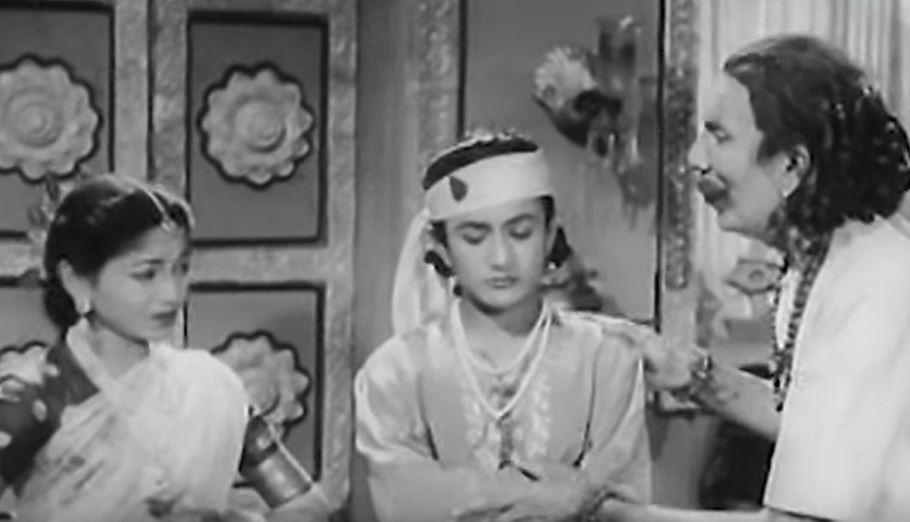
A decade passes. Raghu (Manhar Desai) is now a young man of 25 and still a nastik. Annapurna (Nirupa Roy) and Kishan (B.M. Vyas) have grown up too and Kishan hopes to marry Annapurna. Annapurna is as astik as one can be. She worships many gods including the Naag devta (snake God) in the local temple.
Kishan kills a snake on a tree near the temple. Immediately, the temple and its surroundings start experiencing tremors and a deadly storm engulfs the village. Kishan tries to put the blame on Raghu but Annapurna intervenes and tells the truth about Kishan being responsible for the snake’s death. She begs the Naag devta to restore calm. The storm subsides. During the storm, Raghu saves a child trapped in a building but the child does not survive. Raghu mocks Annapurna that her God did not do anything, else the child would have been alive. And there is no point in her faith and devotion in the almighty. But Annapurna sticks to her faith.


Later, Raghu proposes to Annapurna but Kishan is one step ahead. He has bribed her uncle Gangadhar. Gangadhar declares that Annapurna will marry Kishan. A woman Radha appears claiming Kishan is her husband but runs away. Annapurna smells a rat and threatens to expose Kishan in front of the village. He backs away and Raghu and Annapurna are free to get married. On the day of the marriage, Annapurna leaves the house to perform Naag dev pooja. Kishan’s men kidnap her. She seeks divine intervention from the Naag devta. Miracle! The snake not only unlocks the door but speaks to her and guides her back to the wedding venue on time.

But even after marriage and a closer influence of Annapurna, there is no change in Raghu’s attitude. He tries to uproot the tulsi (basil) plant in their courtyard. On Vat pournima, Annapurna is not allowed to perform pooja. She prays to the goddess, who arrives and blesses her. In spite of all this, she remains a devoted wife and promises her husband she will always follow all his wishes.
Meanwhile Raghu will go to any means to insult God and “disprove” his existence. He invites two brahmins (sadhus), treats them with honour and gives them two pots of wealth. But there are snakes in the pot and the sadhus die a painful death. His father Mahapatra can’t bear this and soon passes away.

Raghu’s mother is unwell too. Raghu is disturbed by the developments and sees the dead sadhus in his dream. Annapurna tells him he needs to perform pitru pooja with bhojan so that his ancestors including his father will be happy and things will be back to normal. But Raghu is not ready to bend. His father appears as a hallucination, pleading to set him free by chanting the name of the almighty. Drama ensues, he sees his father’s soul(?) burning and he finally chants Govind Hare Murari... The contented father’s soul disappears. There is calm and a transformed Raghu meets Annapurna. He is now an astik, on the path of devotion.

Ideally, the story should end here with a happily ever after ending. Sadly that is not the case. Raghu seeks permission from Annapurna to become a sanyasi. She reluctantly agrees as she had promised to be his ever supporting (& sacrificing) better half. Their sorrowful journey continues. There are further hardships planned by Kishan, Gangadhar and other characters to ensure the husband and wife remain separated.
Annapurna is termed a widow by Kishan so that he is free to marry her. He seeks the approval from the King (S.N. Tripathi). The king is an able administrator but the enemies of the mind attack him too and he develops an attraction for Annapurna. He is ready to marry her by bypassing Kishan and killing Raghu (if he was indeed alive).

Phew! And responsible for all this mess are the vices surrounding the human beings on earth. If that were not enough, the Gods too conspire to ensure life is not smooth for all those involved.
The Music
Bharat Vyas and S.N. Tripathi have given some memorable scores. In JJKP, we see a weaker result of their collaboration. The title song by Mohammed Rafi appears multiple times. But one song that has gained all time hit status is Zara saamne to aao chhaliye in the evergreen voices of Mohammed Rafi and Lata Mangeshkar. Set in raga Shivaranjani, this was the surprise top song (sartaj geet) in that year’s Binaca Geetmala countdown hosted by Ameen Sayani.
My Thoughts
The full name of the film is Janam Janam Ke Phere alias Sati Anapurna. It was one of those B-grade mythological movies with special effects made during the period. The film could have been an interesting take on astik v/s nastik but falters badly. There are too many obstacles in the path of the couple and it becomes a tiring watch with the plot going haywire. The only saving grace in the second half is the much awaited song “Zara saamne to aao chhaliye” but the rest is a mess. There are hardly any known faces in the cast and the acting barely leaves any impact.
Perhaps this was the starting point for Manmohan Desai and offered a learning experience. He moved to more commercial cinema and worked with established actors and gave a string of successful movies. His legacy remains but surely JJKP is best to be forgotten expect for that one song which continues to be timeless!
 Cine Gaurav