In 1957, B.R. Chopra made a memorable film which focused on the man v/s machine conflict. The film was Naya Daur which has achieved classic status in Hindi cinema. The audience accepted the realistic theme with its entertaining story line, star cast and music. (It won 3 Filmfare awards for its hero, music director and story writer). More than 25 years later, under the same production (B.R. Films) came Mazdoor which is clearly inspired from Naya Daur. It was directed by B. R. Chopra’s son Ravi Chopra. Unfortunately, it failed to achieve the same status and recall value of its inspiration.
The Plot
Sinha (Nazir Hussain) is the owner of Hiralal Mills named after his son who is currently abroad. Sinha is a caring owner who is not only after profits from the mill but ensures the welfare of his workers. His close associate is the foreman Dinanath Saxena (Dilip Kumar), who also has a caring nature towards the mill and its workers. He has one dream – he is waiting for the day when a mazdoor will be able to write his own destiny. His co-workers include Govinda (Johnny Walker) and Yunus (Yunus Parvez).
Another important character is Ashok Mathur (Raj Babbar). He delivers tiffins to the mill staff and is studying textile engineering. Dinanath is impressed by his hard work and attitude.

We are introduced to Dinanath’s family. His wife is Radha (Nanda). Dinanath purchases cut pieces of cloth from his mill at reduced rates. Radha tries to supplement the family income by selling them in a makeshift shop in their house. They have 2 children, a daughter Meena (Padmini Kolhapure) (who apparently goes to school) and a son Ramesh (Raj Kiran), who is a college student. Ramesh has bunked college for a movie and Dinanath lectures him to be serious etc. He compares him with Ashok who is slogging to be an engineer.

Dinanath invites Ashok to his house and meet his family. Ashok offers some sales advice to Dinanath and Radha. Instead of selling from the house, what if he attempts sell the fabrics around the city? This will help increase the reach and sale. Dinanath agrees and the deal is sealed. Ashok is successful in his mission and soon becomes a household member. Dinanath accepts him as his son and Radha and Meena are impressed too. Only Ramesh doesn’t care about him, he considers him an outsider and insults him regularly.

Things take a sudden turn when Sinha Seth dies due to a heart attack. His son Hiralal (Suresh Oberoi) arrives to take over the management of the mill. But father and son are not cut from the same cloth. Hiralal is money minded. He is ready to go to any extremes to make money, be it at the cost of the workers’ well being. Aiding him is corrupt Daulatram (Madan Puri).
The mill has earned a huge profit that year. But Hiralal wants to increase the production by purchasing new machinery. He announces there will be no bonus for that year, and this is a shock for the workers. A crestfallen Dinanath comes home with the news. He tells Radha that he doesn’t care for his own bonus but his fellow workers had made plans in anticipation which now lay shattered. As a diversion, his mood is uplifted by Ashok who has managed to sell almost all the cut pieces and make a profit.
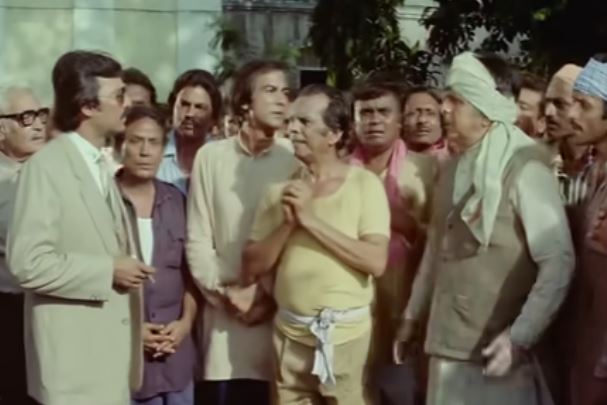
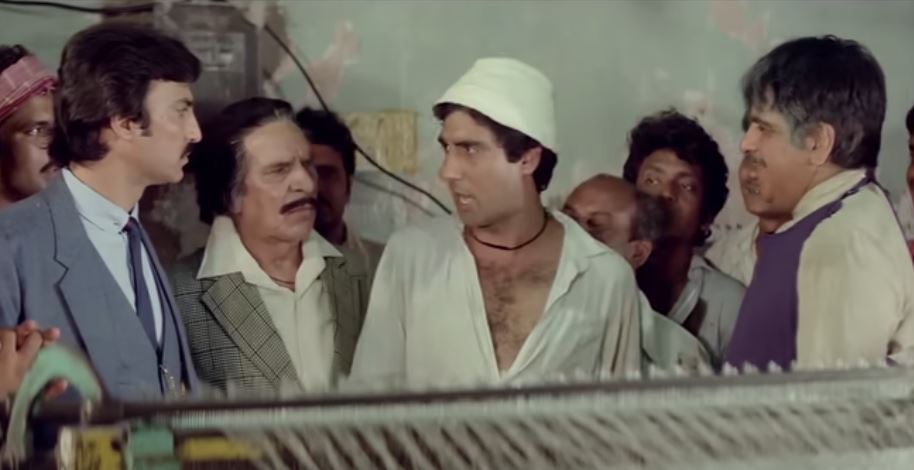
In the mill, Ashok gets introduced to Hiralal. One day, a machine suddenly stops working and Hiralal is aghast as the mill engineer is on a month’s leave. Work cannot be stopped because of one person’s absence. In steps Ashok, who repairs the machine (almost!) in a jiffy. He quotes a sum of Rs 1,000 as his charges stating he decides his own price. He gets paid and he offers the money to Dinanath as he looks up to him as his father. It is agreed that Dinanath will buy more cut pieces from the amount to continue their business deal.
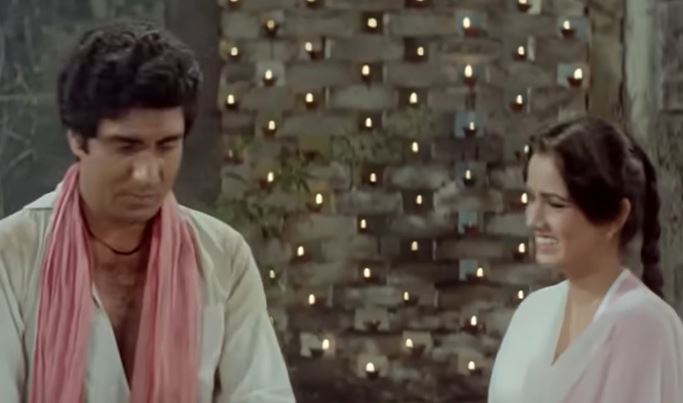
Now it is time to introduce the inevitable love angle. Meena is falling for Ashok. Ashok is getting closer to a stranger Smita (Rati Agnihotri) with whom he has had a chance meeting. In short, both ladies are falling for the same man, leading to future complications.

Things are not going smooth between Hiralal and the workers. A worker Raju dies in an accident while on duty. The workers take him to the hospital and attend his last rites. Hiralal is furious that the work has stopped randomly. He confronts Dinanath who lectures him on humanity, ethics etc which have no effect. Hiralal decides to suspend Dinanath for 10 days and cut the wages of the workers.

Dinanath can’t digest the injustice done to the workers. He is ready to be suspended but does not want the workers to suffer. He attends the mill’s Annual General Meeting and raises his voice on behalf of the workers. Hiralal offers him to sign an apology after which things will return to normal. Dinanath insults Hiralal by tearing the apology document and voluntarily resigns.
The workers misunderstand and think he has been sacked. They offer to go on strike but he explains the situation, pacifies them to continue working and returns home.

On the same day, Ashok comes with good news – he has passed the exam and is now an engineer. Dinanath takes Ashok to a burnt mill to check if it can be made operational again. They need to pay Rs 3 lakhs but Dinanath has only Rs 25,000 which he pays as advance. They attempt to take loans but are unsuccessful. (In the background, Hiralal is ensuring they are not successful in arranging the money. He cannot forget his insult and is waiting to extract his revenge).
The deadline to pay the balance amount approaches when their savior enters the scene. This is Mr Kundanlal Batra (Iftekhar), a well known businessman. He knows everything about Dinanath and wants to help him out. And coincidence! Smita turns out to be his daughter.
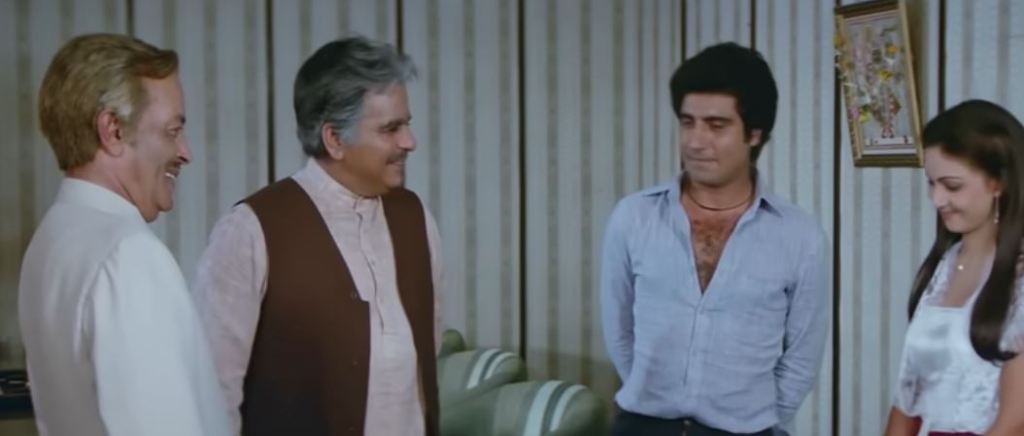
So, Dinanath is now a mill owner and he and Ashok begin the tough job of starting production as soon as possible. The beginning is tough but they are soon joined by their old colleagues Govinda, Yunus and the lot. The cloth from their mill is of high quality. Hiralal makes moves to stop their goods from reaching the market, so they sell the garments and fabrics in a makeshift market on the road. This further frustrates Hiralal.
Overall, there is smooth sailing. Dinanath Saxena is now a rich and reputable businessman in the city. Dinanath proposes that Ashok marry Meena and all of them can stay together. Ashok is unable to confess his love for Smita openly considering all that Dinanath has done for him. He reluctantly marries Meena, leaving Smita devastated. Then Smita makes a plan to marry Ramesh, so she can enter his house and spend time with Ashok.

Thus the story line evolves into a love triangle leading to disastrous consequences. Things reach a point where Dinanath disowns Ashok and asks him to leave the house and mill permanently. Ramesh is fully supportive of his father’s actions. He was never in favour of the orphan Ashok anyway.
The workers are against this decision to remove Ashok and go on strike. What will happen? Will Dinanath be able to resolve the labour problem? Will Hiralal be successful in taking his revenge? And what happens to Ashok on a professional and personal front? Will he be forgiven by the Saxena family?
The Music
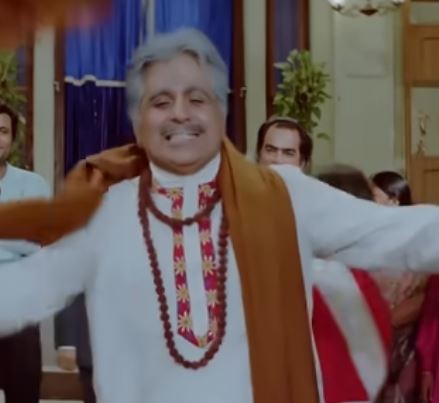
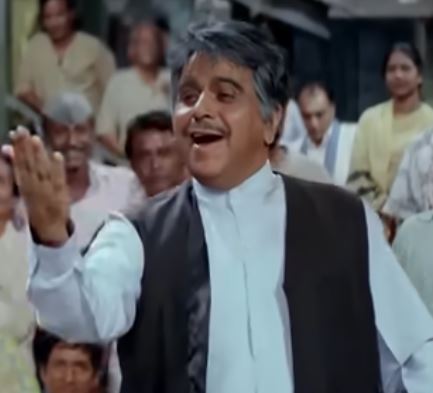
The comparison with Naya Daur’s music is inevitable. Unfortunately, lyricist Hasan Kamaal’s and R.D. Burman’s collaboration hardly leave an impact. Many songs are an opportunity for Dilip Kumar to showcase his dancing skills – Hum Mehnatkash Is Duniya Se, Pet Mein Roti, Tan Par Kapda and Nana Ho Gaya Diwana, where Mahendra Kapoor provides the playback. They have nothing new to offer. The others are sung by by Asha Bhosle (Baat Adhoori Kyon Hai and Tumhein Bhool Jaane Ka Haq Hai Magar) and Salma Agha (Pehla Pehla Pyar Na Bhoole).
My Thoughts

As evident, the movie falls to achieve the status of its predecessor Naya Daur. Its focus on the “mazdoor” is lost in between as romance and marital discord take priority. Maybe the filmy touches dilute the effect. It would have been interesting to see the ideological clash between the maalik and the mazdoor with its twists and turns leading to a satisfying end as in Naya Daur.
Dilip Kumar occupies every frame and performs effectively. His typical mannerisms and dialogue delivery impress at the beginning but become repetitive as the story progresses.
Suresh Oberoi’s character makes a mild villain in front of the veteran acto’s character. Maybe that was intentional. The other characters perform as required but don’t have much to contribute. Raj Babbar has some impressive dialogues which he delivers effectively. It is probably the only film featuring Dilip Kumar and Nanda together. Trivia: Dilip Kumar, Nazir Hussain and Johnny Walker had starred in Naya Daur as well as Mazdoor.
 Cine Gaurav