I have been an avid reader of Agatha Christie’s works and admire her style of writing, the plot development and suspense in most of them. It is difficult to guess the murderer till the very end and therein lies the success of her writing. The 2 most loved characters she created were Hercule Poirot and Miss Marple who feature in many novels and short stories doing what they do best – pursuing the culprit and solving the mystery.
Appointment With Death was first published in 1938. It may not be as famous as some other novels but nevertheless was a good mystery with all the usual elements. Not to forget the presence of Poirot who unmasks the murderer with his sleuthing skills. I came across this movie adaptation and decided to view and write about it. It stars Peter Ustinov as Poirot. The movie is produced and directed by Michael Winner. Is it a winner, lets see?

The Plot
The protagonist is Emily Boynton (Piper Laurie), a rich lady based in the United States. Emily’s husband is dead and the family lawyer Jefferson Cope (David Soul) is reading out the contents of the will to Emily. Apparently there are 2 wills under consideration. The first will makes Emily the sole beneficiary leaving nothing for her children. However the second (and last will) allocates a sum of 200,000 dollars to each beneficiary. Emily doesn’t care about the second will as that will involve sharing the money with her children. She has no intention of doing so.
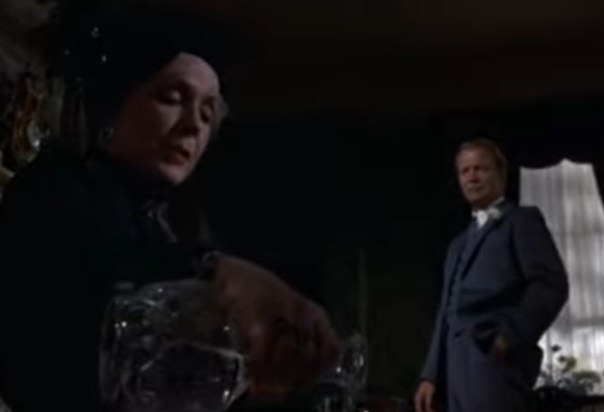
Emily has a strong personality. She had been a wardress in a prison when she met her future husband Mr Boynton (who was the Governor). She worked for 14 years in the prison and knows a lot about crime and criminals. She likes to lord over people, have a hold over them and make them do as she wants. She tells Jefferson bluntly that she knows about a fraud committed by him and she is happy to inform the US Law Society which will destroy his career. Jefferson pleads her not to do that. She orders him to burn the second will, which he does having no choice. It is time to inform the children.
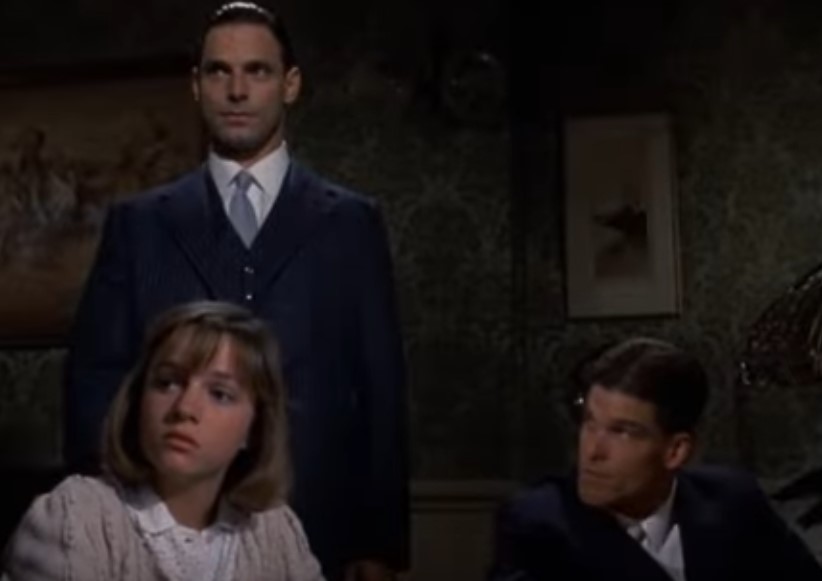
The children are called in and are shocked to hear that their mother is in full control of the family fortune. They will be entitled to the money but only upon her death.
Emily has 3 step children. The eldest is Lennox (Nicholas Guest), his wife is Nadine (Carrie Fischer). Then Raymond (John Terlesky) and Carol (Valerie Richards). Ginevra or Jinny (Amber Bezer) is her real daughter but she is treated the same as the others. The helpless children have no option but to accept the situation. Emily is satisfied.
Soon after, the family goes to visit Europe. They visit London, followed by Trieste in Italy.

Here we are introduced to other important characters in the story. Lady Westholme (Lauren Bacall) is an American woman who married a British man after meeting him on a ship. She acquired British citizenship after marriage and became a Member of Parliament (MP) after 10 years. Given her influential status, she tends to be bossy and have her way. With her is Miss Quinton (Hayley Mills), an archaeologist.


Dr Sarah King (Jenny Seagrove) has recently graduated and is a qualified doctor. She helps Emily when she stumbles during a sightseeing tour. Later in the story, Emily’s son Raymond falls in love with Sarah, to the obvious displeasure of his mother.
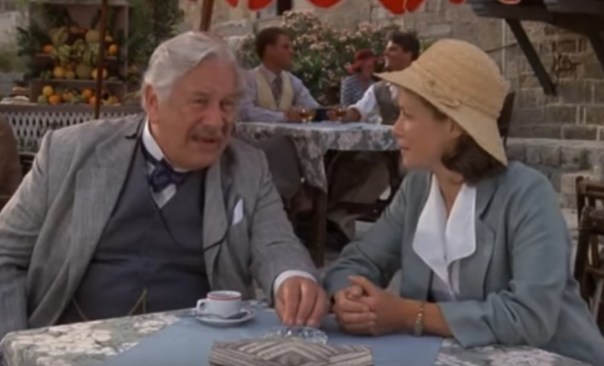
And finally Hercule Poirot who is taking a well deserved vacation. He is an old friend of Sarah King and both are surprised to see each other. It seems Poirot is always “well placed” to overhear some important pieces of conversation involving Emily which are going to be important as the story progresses. Particularly when her children are discussing the injustice done to them and how good it would be to get rid of her!
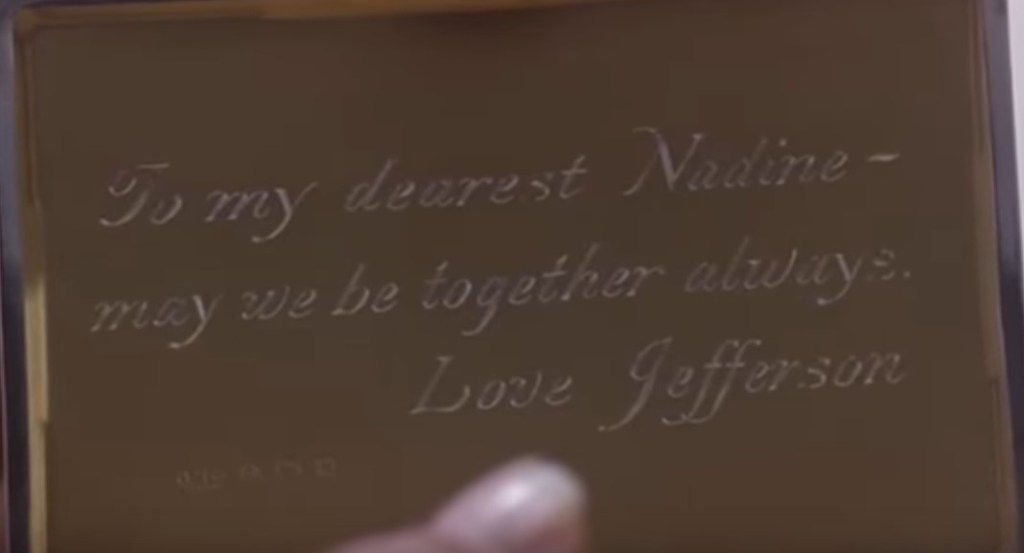
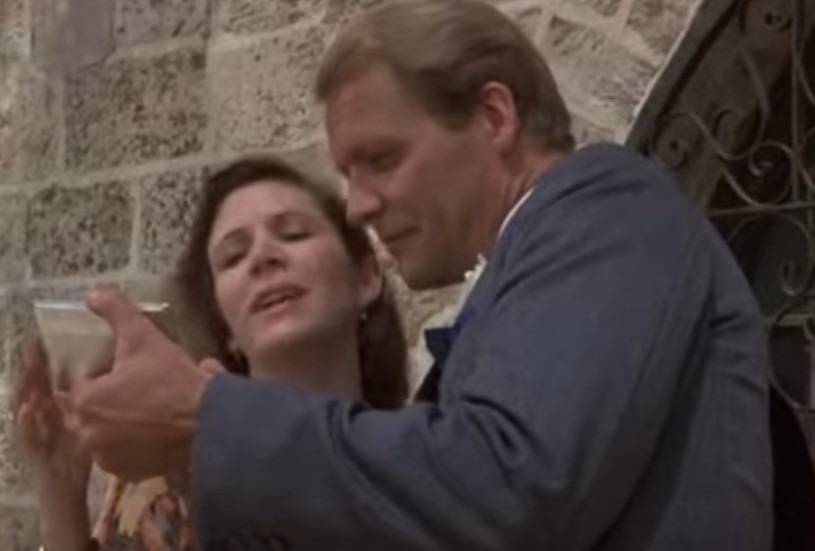
Jefferson, the lawyer makes an unscheduled appearance in Trieste. Emily is not happy at this development but her daughter in law Nadine is. Nadine is having an affair with Jefferson and is pleased to be closer to him. He gifts her a cigarette case with a message declaring their closeness. Obviously, this will cause hell if it gets revealed to Nadine’s husband Lennox or Emily.

The group boards a ship to go their next stop of Jaffa, Palestine (I guess Israel did not exist as an independent state when the book was published). On the ship, Emily and Jefferson have a decent talk. She knows of his affair with Nadine. He requests her to be considerate and give some money to the children. She mellows down a bit and invites him to join them for dinner that night.
At dinner, Emily makes a show of pouring wine for everyone. But her intention is to poison Jefferson by adding a high dose of her medicine digitalis in his wine glass. (Emily is shown consuming the medicine at the beginning of the movie and highlights that it is dangerous to exceed the dosage mentioned).

But Jefferson does not drink the wine. He is interrupted by Lennox who has found the cigarette case in his wife’s possessions. He confronts Jefferson and punches him as he is about to sip the wine. The glass falls down. A shrewd Poirot observes that the cockroaches under the table who “taste” the wine are dead. (Seriously, are there so many cockroaches on that ship??)

They arrive in the holy land (Jerusalem?). Colonel Carbury (John Gielgud), an acquaintance welcomes Poirot. A curious Poirot continues to observe the goings-on in the Boynton family. One night, Poirot sees Emily handing over money to an Arab for “getting the job done.” He wonders what this is about.
Raymond is getting closer to Sarah. At one point, Emily forbids Raymond to meet Sarah. Miffed by this ridiculous behaviour, Sarah approaches Emily and lectures her. Emily retorts vaguely, “I don’t forget anything, not an action, a name, a face.” Is this a warning? Does she know something from Sarah’s past?
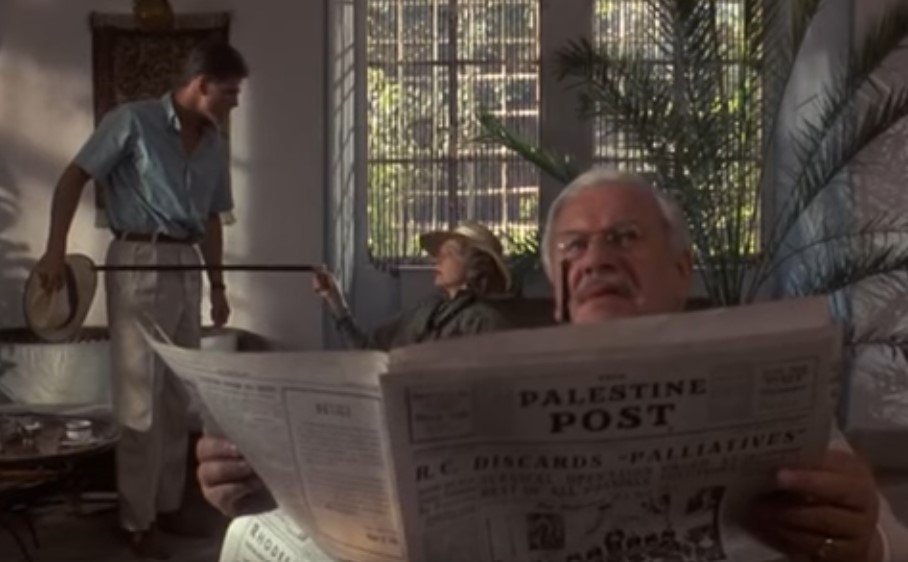
The group continue their journey in Jerusalem and later in Qumran, which is an archaeological site. In Qumran, Emily, in a surprisingly good mood asks Raymond and Sarah to take a walk after lunch. She says the same to Lennox, Nadine and Jefferson, asking them to be mature and behave civilly. Carol is sent with Miss Quinton. Meanwhile Emily settles down outside her tent on a chair. She invites Lady Westholme to have a chat with her.
The group is surprised at Emily’s behaviour but proceed on the walk, away from the site. They return one after the other. In the evening, Sarah sees a servant trying to wake Emily who appears to be asleep. She rushes over to find her dead. Sarah assumes it is because of her heart condition.
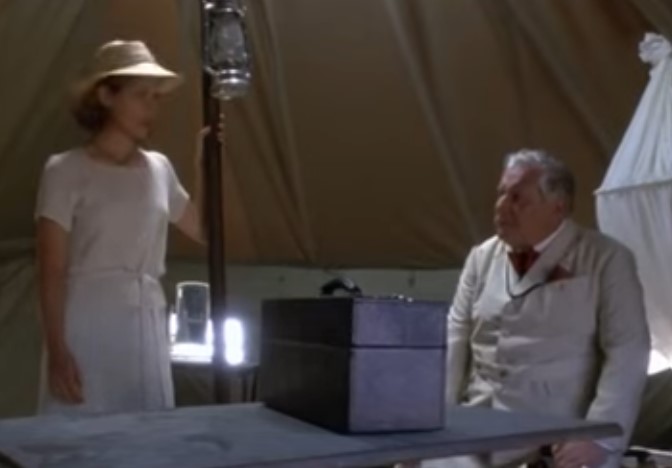
But Poirot is not convinced. He deduces that Emily did not die of natural causes. Upon investigating, he finds that Sarah’s bottle of digitalis is empty, so is a syringe missing from her medical bag. He infers that Emily was injected a lethal dose of the medicine that caused her death.
He requests his friend Colonel Carbury to give him a couple of days to find the murderer. Obviously, it has to be someone from the group, and multiple people had motives to wish Emily was dead – the sooner the better.

So, who did it?
My Thoughts
The film pales in comparison to the book. The book gives a detailed background of all characters, particularly the Boyntons. Emily is portrayed as a tyrant who has a tight grip over her children. It is as if she is still running a prison and the children can hardly dare to think of freedom. In the movie, Emily is a forced evil character. The underlying state of intense tension between her and the children is missing. Overall, the characters are introduced poorly. The murder and its aftermath involving the investigation should be gripping but it fails to engage you. There are a few thrilling moments towards the end which includes another murder but that’s about it. The performances by the well known cast are less than impressive and the exotic locations also fail to match the mood of the novel.
Peter Ustinov’s Poirot doesn’t remind you of the character with its idiosyncrasies created by the writer. He is funny but appears bored and doesn’t add much to the lackluster proceedings.
This adaptation might work as a stand alone film but is not a treat for fans of Agatha Christie.
 Cine Gaurav
Nice review.
You said it pales in comparison to book. But I haven’t read the book either.
LikeLiked by 1 person