All posts by GGaurav

Unknown's avatar

About GGaurav

I am passionate about old movies, songs and trivia.

Naushad – Challenge and Competition Songs

Today’s post is dedicated to the late music director Naushad Ali (born 1919), his birthday falls this week on 25 December. He was a passionate advocate of Indian classical and folk music, which he used predominantly in his compositions.

Today’s list theme involves a competition or challenge situation occurring in the movie’s story line, which then results into a song. All 10 songs are based on this situation and composed by Naushad, which in a way showcase his range and versatility. Hope you enjoy and do leave your comments on this great composer.


1) Song: Aaj Gawat Mann Mero Jhoomke
Film: Baiju Bawra (1952)
Credits: Shakeel Badayuni | Naushad | Ustad Amir Khan and Pt. D. V. Paluskar

The first song in the list is a direct face-off between Tansen (Surendra) and Baiju (Bharat Bhushan in Akbar’s court. Its a singing competition where the two accomplished singers will sing all through the night and try to melt a block of marble demonstrating their singing prowess. A classical number in raag Desi, brilliantly performed by stalwarts Ustad Amir Khan (singing for Tansen) and Pt. D. V. Paluskar. It makes for an exciting watch as the outcome will decide if Baiju will be able to avenge his father’s death and fulfill his life long objective of killing Tansen.

Prem ke karan premi gaawe,
Taanon se patthar pighlaawe,
Jagat mein rahe maan re
Aaj gawat mann mero jhoom ke


2) Song: Chandan Ka Palna
Film: Shabab (1954)
Credits: Shakeel Badayuni | Naushad | Hemant Kumar

Another royal setting. Here the princess (played by Nutan) suffers from insomnia. However hard she tries, she is unable to have a peaceful sleep. She realises that music may be a remedy to her ailment. Soon musical exponents from all over are invited and challenged to cure the princess with a display of their talent. Many come and try but are unsuccessful. Finally, the hero (Bharat Bhushan) accepts the challenge. He presents this moving lullaby set in raag Pilu and emerges successful. Naushad makes use of very few instruments fitting the situation and Hemant Kumar sounds soothing.


3) Song: Teri Mehfil Mein Kismat Azamaakar
Film: Mughal-e-Azam (1960)
Credits: Shakeel Badayuni | Naushad | Lata Mangeshkar, Shamshad Begum and Chorus

It is entertainment hour for Prince Salim (Dilip Kumar). Anarkali (Madhubala) and Bahar (Nigar Sultana) compete against each other in bait baazi (a verbal game of Urdu poems). They are presenting the differing perceptions about the concept of love. Prince Salim will pick the winner.

Mohabbat Karne Waalon Ka Hai Bas Itna Hi Afsana,
Tadapnaa Chupke Chupke Aahe Bharnaa Ghut Ke Mar Jaana,
Kisi Din Ye Tamasha Muskuraa Kar Ham Bhi Dekhenge,
Teri Mehfil Mein Kismat Azamaakar Hum Bhi Dekhenge,
Aji Haa Ham Bhi Dekhenge


4) Song: Madhuban Mein Radhika
Film: Kohinoor (1960)
Credits: Shakeel Badayuni | Naushad | Mohammed Rafi and Ustad Niaz Ahmed Khan

Rajlakshmi (Kumkum) is ready for her dance performance but the experienced musicians are not ready to play for a “fresher.” A young man Rajkumar Dhivendra Pratap (Dilip Kumar) steps in. He is ready to perform with her as a singer cum musician. They end up challenging each other. The dancing, singing, music are all top notch. Dilip Kumar plays the sitar convincingly in this raag Hameer composition.


5) Song: Mere Mehboob Tujhe
Film: Mere Mehboob (1963)
Credits: Shakeel Badayuni | Naushad | Mohammed Rafi

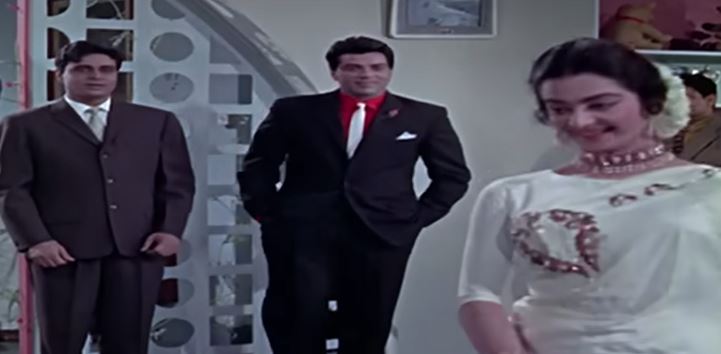
This is an annual mushaira, where Urdu poets are competing by reciting their shayari compositions. One of the participants is the hero Anwar (Rajendra Kumar). He presents this romantic song. It is dedicated to the burkha clad girl he had collided with, resulting in a romantic encounter. Once again, the focus is on the poetry presentation and singing with minimal use of instrumentation.

Bhool sakti nahin aankhen woh suhana manzar,
Jab tera husn mere ishq se takraraya tha,
Aur phir raahon mein bikhare the hazaron naghmein,
Mein woh naghmein teri aawaz ko de aaya tha,
Saaz-e-dil ko unhi geeton ka sahara de de,
Mere khoya hua rangeen nazaara de de,
Mere mehboob tujhe…


6) Song: Mere Mehboob Mein Kya Nahin
Film: Mere Mehboob (1963)
Credits: Shakeel Badayuni | Naushad | Lata Mangeshkar and Asha Bhosle

From the same movie, we have another song between 2 friends Husna (Sadhana) and Naseemara (Ameeta). They are conversing about their respective beloved which soon progresses into a competitive song. Through the song they describe him and try to outdo each other. There is a lot of comparison, adjectives and superlatives used. Both are unaware they are describing the same person which is going to lead to complications!

Mera mehboob ek chaand hai husn apana nikhaare huey,
Asmaan ka farishta hai woh roop insaan ka dhaare huey,
Rashk-e-jannat hai woh mehejabin,
Mere mehboob mein kya nahin


7) Song: Aaj Hai Pyaar Kaa Faisla
Film: Leader (1964)
Credits: Shakeel Badayuni | Naushad | Lata Mangeshkar

Leader is a mess of a movie. This song is a dream/fantasy sequence which appears randomly in the plot. Dilip Kumar and Vyjanthimala are on the run. He is injured and they take refuge in a temple during a stormy night. He is resting. She lies down next to him and enters a dreamy world. Her lover has been converted to stone. She is challenged to bring him back through her love and dedication. And being a Hindi movie heroine, this is an opportunity to display her impactful singing and dancing skills! A random song but nevertheless beautiful composition by Naushad.


8) Song: Saaz Ho Tum
Film: Saaz Aur Awaaz (1966)
Credits: Khumar Barabankvi | Naushad | Mohammed Rafi

A contrived situation resulting in a challenge. An uninvited Joy Mukherjee meets Saira Banu. She is angry with him and they insult each other. He challenges her she won’t be able to control herself and start dancing once he begins singing. And that is what happens. Naushad blends many raagas and instruments in this song. A melodious number with impressive singing by Rafi.


9) Song: Teri Payal Mere Geet
Film: Teri Payal Mere Geet (1993)
Credits: Hasan Kamal | Naushad | S. P. Balasubrahmaniam

This is one of Naushad’s last movies. The song is between a dancer Laila (Meenakshi Sheshadri) and singer Premi (Govinda). Laila has been invited to perform at a wedding but refuses to perform due to personal reasons. She makes an excuse that she is unable to think of a song. Premi volunteers to sing a song and she can accompany him. Both challenge each other and end up performing together. While the song is forgettable, Meenakshi’s dancing is exquisite and a delight to watch.


10) Song: Ishq Ki Dastaan
Film: Taj Mahal: An Eternal Love Story (2005)
Credits: Naqsh Lyallpuri, Syed Gulrez | Naushad | Kavita Krishnamurthy and Preeti Uttam

This was the last movie in Naushad’s career. The song is a qawwali style competition between the 2 performers Arjuman Bano (Sonya Jahan) and Ladli Begum (Kim Sharma). While one talks about being open about love, the other counters stating that love is a feeling and doesn’t need to be made public.

Raj Kapoor – Self-Description Songs

14th December 2024 was Raj Kapoor’s 100th birthday. Widely regarded as the first showman of Hindi cinema, he carved a place for himself as a successful actor and director. Controversies apart, his all time hit movies and evergreen songs have made him an endured figure in cinematic history. Today’s post is dedicated to this showman. In all the songs, he talks about himself. Some are an introduction to his character while some show his state of mind or how he was treated by others.


1) Song: Main Zindagi Mein Hardam Rota Hi Raha Hoon
Film: Barsaat (1949)
Credits: Hasrat Jaipuri | Shankar Jaikishan | Mohammed Rafi

This was the second movie directed by Raj Kapoor which established his banner R.K. Films. It marked the successful entry of Shailendra, Hasrat Jaipuri and Shankar-Jaikishan in the RK camp. In this song, he is expressing his state of despair as the lyrics tell us. Also this is one of the few songs sung by Mohammed Rafi for Raj Kapoor considering Mukesh was his “regular” playback voice.

Umeed ke diye bujhe dil me hai andhera,
Jeevan kaa to saathi na bana koi bhi mera,
Phir kiske liye aaj main jeeta hi raha hoon,
Main zindagi mein hardam rota hi raha hoon


2) Song: Awara Hoon
Film: Awara (1951)
Credits: Shailendra | Shankar Jaikishan | Mukesh

What can be said about this song? It is so iconic! It established the Charlie Chaplin inspired tramp character firmly in the minds of the audience. The general image of a simple, vulnerable yet charming man continued throughout his career.

Ghar-baar nahin, sansar nahin, mujhse kisi ko pyar nahin,
Us paar kisi se milne ka iqrar nahin, mujhse kisi ko pyar nahin
Sunsan nagar anjaan dagar ka pyara hoon,
Awara hoon, awara hoon


3) Song: Main Dil Hoon Ek Armaan Bhara
Film: Anhonee (1952)
Credits: Satyendra | Roshan | Talat Mahmood

Raj Kapoor on the piano, singing for Nargis (who had a double role). A rare song by Talat Mahmood for Raj Kapoor with Roshan as the music director. A simple tune which suits the character and the mood. (Trivia – The lyrics are by Satyendra Athaiya who later married Bhanu Athaiya.)

Khud maine husna ke hathon mein,
Shokhi kaa chhalakataa jaam diyaa,
Gaalon ko gulaabon kaa rutabaa,
Kaliyo ko labo kaa naam diyaa, naam diyaa
Aankho ko diyaa saagar gehraa,
Tu aake mujhe pehchaan zaraa,
Main dil hoon ik aramaan bharaa…


4) Song: Main Paagal, Mera Manwa Paagal
Film: Ashiana (1952)
Credits: Rajinder Krishan | Madan Mohan | Talat Mahmood

Another beautiful song by Talat Mahmood, set to tune by Madan Mohan in raag Kedar. Raj Kapoor in a sad mood talking about separation.

Kahe ye duniya mai diwana,din mein dekhun sapne,
Diwani duniya kya jaane, Ye sapne hai apane,
Ghayal mann ki hasi udaaye, ye duniya ki reet re,
Main paagal mera manwa paagal, paagal meri preet re


5) Song: Mera Joota Hai Japani
Film: Shree 420 (1955)
Credits: Shailendra | Shankar Jaikishan | Mukesh

Similar to Awara hoon, this is another iconic song. The clever lyrics ending with the line “Phir Bhi Dil Hai Hindustani” was catchy and instantly caught the imagination of the listener. Raj Kapoor portraying the unemployed common man character who adapts as the movie plot progresses.

Nikal Pade Hai Khulli Sadak Par Apna Seena Taane,
Manzil Kahan, Kahan Rukna Hai, Uparwala Jaane,
Badhte Jaayen Hum Sailani, Jaise Ek Dariya Toofani,
Sar Pe Laal Topi Roosi Phir Bhi Dil Hai Hindustani,
Mera Joota…


6) Song: Sab Kuch Seekha Humne
Film: Anari (1959)
Credits: Shailendra | Shankar Jaikishan | Mukesh

Raj Kapoor plays an innocent and gullible character who doesn’t know how to play smart and earn money. He comes to know the truth about his love interest (Nutan). She was deceiving him by acting as a poor maid in need of money whereas she is actually a rich heiress. When reality bites, the hero sings this song confirming he is an anari, someone who was not smart and got easily fooled.

Asli nakli chehre dekhe, dil pe sau sau pehre dekhe,
Mere dukhte dil se puchho, kya kya khwab sunehre dekhe,
Toota jis tare pe nazar thi hamari,
Sach hai duniya walon ke hum hai anari


7) Song: Chhalia Mera Naam
Film: Chhalia (1960)
Credits: Qamar Jalalabadi | Kalyanji Anandji | Mukesh

Raj Kapoor giving his introduction as a chhalia (cheat / trickster). The picturization is similar to Awara Hoon where he roams in the street describing himself and robs a rich passerby.

Main hoon galiyon ka shahazaada, jo chaahun woh le loon,
Shahazaade talavaar se khelen, main kainchi se khelun,
Mehanat mera kaam, dena us ka kaam,
Hindu muslim sikh isaai sab ko mera salaam
Chhalia mera naam…


8) Song: Mera Naam Raju
Film: Jis Desh Mein Ganga Behti Hai (1960)
Credits: Shailendra | Shankar Jaikishan | Mukesh

His home production. The song is shot along the Ganga river. Raj Kapoor is once gain playing the simple man character who joins a gang of daakus (bandits). This time he is introducing himself as an orphan and a singer.

Kaam naye nit geet banana,
Geet bana ke jahan ko sunana,
Koi na mile to akele mein gaana,
Kaviraj kahe na yeh taj rahe, na yeh raaj rahe, na yeh raaj gharana
Meet aur preet ka geet rahe, kabhi loot saka na koi yeh khazana
Mera naam Raju gharana anaam


9) Song: Main Aashiq Hoon Baharon Kaa
Film: Aashiq (1962)
Credits: Shailendra | Shankar Jaikishan | Mukesh

A relatively unknown movie of Hrishikesh Mukherjee, the song picturization is not so great. Raj Kapoor is wandering around looking bored and singing the song. He describes himself as a traveller and basically a lover of nature and beauty.

Sadiyon se jag mein ata raha main,
Naye rag jeevan me lata raha main,
Har ek des me nit naye bhes me,
Mai aashiq hun baharo ka, fizaon ka nazaron ka


10) Song: Diwana Mujhko Log Kahein
Film: Diwana (1967)
Credits: Hasrat Jaipuri | Shankar Jaikishan | Mukesh

This was one of Raj Kapoor’s last movies as a leading man. And in this phase it was jarring to see him play the innocent character (again!) and act with younger heroines like Saira Banu, Rajshri and Hema Malini. He describes himself as a “seedha saadha” person misunderstood by the people around.

Main insaan seedha saadha hoon,
Imaan ka main shehzaada hoon,
Hai kaun bura malik jane,
Main pyar ka parwana,
Diwana mujhko log kahen…

Satyakam (1969)

Lets’s begin with some trivia today. What’s special about 8 December? Its Dharmendra’s birthday. Its also Sharmila Tagore’s birthday. Frequent co-stars, they have starred together in multiple movies such as Anupama, Devar, Mere Humdum Mere Dost and Chupke Chupke. And Satyakam, on which today’s post is based upon. Satyakam is regarded as a masterpiece of director Hrishikesh Mukherjee.


The Plot

The movie begins with a voiceover by Narendra/Naren Sharma (Sanjeev Kumar). He is narrating the mythological story of Jabala and her son Satyakam. Satyakam goes to Gautam. He requests Gautam to accept him as his disciple. Gautam asks him what’s his “gotra“. When Satyakaam asks his mother, she replies he was born after she serviced several men and she cannot confirm who was his father. But her name is Jabala and his name is Jabal Satyakam. When Gautam hears this from Satyakam, he proclaims Satyakam is a real brahmin as he had the guts to speak the truth. Naren then then starts narrating the story of the modern Satyakam.

It is pre-independence time. Naren and his best friend Satyapriya (Sath) Acharya (Dharmendra) are engineering students, awaiting their results. Satyapriya, true to his name is a stickler for honesty. The results are out and both are now engineers having cleared the exams successfully. The college students are traveling back home. Unfortunately, the bus meets an accident and they lose one of their friends in the tragedy. Sath and Naren escape with minor injuries.

Sath clears an interview with United Paper Mills in Mumbai. The managing director Shyam Sunder (Rajan Haskar) interviews him. Ananto Chatterjee (Rabi Ghosh), the overseer is his colleague. Sath comes to know from Chatterjee that there is no work in the office. He has joined a couple of months back and waiting for work to be allotted. Sath is uncomfortable hearing this. Being the “principled” employee, he cannot earn money by sitting idle.

There is a board meeting and he is introduced to the company’s owner Kunwar Vikram Singh (Manmohan) of Bhawanigarh, a princely state in central India. Sath openly questions him about the commencement of his work. Kunwar informs that Sath’s work is to survey land in his state as they are planning to open a new mill there. The next day, Kunwar & Shyam Sunder along with Sath and Chatterjee leave for Bhawanigarh.

Its June, 1947. At this point, through a radio announcement, the movie incorporates the topic of the annexation of princely states in the soon to be independent India. Kunwar is listening to the radio and is not happy as he awaits his own fate and that of Bhawanigarh.

Sath, Chatterjee and Shyam Sunder are staying at the guest house. The caretaker is Rustom (David). They are served by a young girl Ranjana (Sharmila Tagore). Ranjana’s mother had run away with a driver. Apparently, Ranjana is the driver’s daughter. Kunwar has his sights on her and she entertains him with a song when he is alone in his suite.

Next day onwards, Sath and Chatterjee begin the land survey. They are waiting to be provided with important equipment like theodolite but only get assurances. Sath is restless as he believes in the output and value of his work. Its July, 1947 and Chatterjee tells Sath that they should run away because the future of Kunwar and Bhawanigarh is unclear. Sath convinces him to stay and continue their work. But other circumstances are going to interfere soon and change Sath’s life forever.

One night, Rustom pushes Ranjana and forces her to spend the night in Sath’s room. Sath maintains his distance from her. The next morning, Rustom tells Ranjana’s story to Sath. Due to the unpleasant reputation and deeds of her mother, Ranjan’s fate is bleak. Who will marry such a girl? Her life will be spent entertaining characters like Kunwar. Sath comments generally that anyone will be happy to marry such a beautiful girl. Rustom challenges him if he will do it. Sath realises he cannot. It is easier to talk than commit.

Further, Rustom tells him to take care of Ranjana for a few days as he will be going to Bhopal. She starts accompanying Sath to the survey site and spends time with him. She begs him to take him away from this place; she is ready to serve him as a servant but he tells her it is not possible. A situation arises after Ranjana is raped by Kunwar. It is further revealed she is pregnant and there are questions around the father’s identity. Sath makes the hard decision to marry her in spite of knowing all the background.

Kunwar’s true intentions in employing Sath also get disclosed. He wanted an engineer urgently to sign the land survey document for submitting to the registrar. Seems he wants to exploit the land for other reasons. But Sath is not ready to be bribed.

Sath and Ranjana marry and settle down. They have a son called Kabul (Sarika). Dadaji refuses to accept Ranjana because of her questionable past and Kabul, as he is not Sath’s son.

Due to Sath’s principled nature, he is not able to hold on to a job for long. He encounters corruption at every stage that demands him to make compromises in some form, which are not acceptable to him. Thus they keep moving around. Ranjana accepts this meekly.

A time comes when Naren and Sath meet again. But this time Naren is Sath’s boss. Naren is taken aback by Sath’s attitude towards honesty and inability to bend for practical reasons. There is a corrupt contractor Mr Ladia (Tarun Bose) who wants Sath’s signature on some documents which will benefit Ladia hugely. As expected, Sath refuses. Naren asks him to be realistic but Sath sticks to his stand.

Thus Sath’s life continues with more hardships on the way. One day, Naren comes to know Sath is in the hospital and being treated for last stage cancer. Mr Ladia is supporting the family. Sath is worried about Ranjana and Kabul’s future. Ladia is willing to help to seal the family’s future by giving Rs 25,000 only if Sath agrees to forget his principles and sign the pending documents that Ladia was chasing him for. He shares this proposition with Ranjana and requests her to convince Sath and get his signature.

Ranjana contemplates Ladia’s offer and lectures Sath that he never thought about them before. What will they do once he is dead? Will he be happy if she becomes a prostitute like her mother and what about Kabul’s future, where will the money come from? This leaves Sath in a dilemma. His one and only compromise will secure his family’s future but will he do it?

The Music

There are only 3 songs which are forgettable. Lyrics by Kaifi Azmi and music by Laxmikant Pyarelal.

My Thoughts

While an unconventional subject, Hrishikesh Mukherjee handles it deftly. The movie avoids being preachy. Mukherjee resolves Sath’s dilemma effectively and ties up the climax with the original story of Jabala and Satyakam. There are some lighter touches which are a trademark of Mukherjee’s direction. Sath’s unwavering stand on principles may seem a bit far fetched but he has a position that one has to start somewhere for honesty to prevail in the society. Even the independence of the country did not help to change things and that’s his regret. The dialogues by Rajinder Singh Bedi are impactful (he won the Filmfare award for this movie).

This is definitely one of Dharmendra’s finest performances. Too bad, he did very few of such characters in his long career. Sharmila Tagore, Sanjeev Kumar and Ashok Kumar are all good in their roles. Interestingly, Sanjeev Kumar is credited as “and Sanjeev Kumar” in the titles.