6th September was Rakesh Roshan’s birthday (born: 1949). The son of well known music composer Roshan, he entered the film industry as an actor and moved to producing and directing films. He launched his production company Filmkraft, and Aap Ke Deewane was its first offering. According to the credits, the film is produced by Vimal Kumar and directed by Surendra Mohan. The movie was a flop but he achieved success later with his “K” series movies like Khoon Bhari Maang, Karan Arjun, Kaho Na Pyar Hai and Koi Mil Gaya to name a few.
Aap Ke Deewane is primarily based on the theme of friendship between the 2 leads (Rakesh Roshan and Rishi Kapoor) who belong to different religions. The strength of their friendship is tested many times and they need to overcome the obstacle every time, ensuring a win-win outcome for both of them.
The Plot
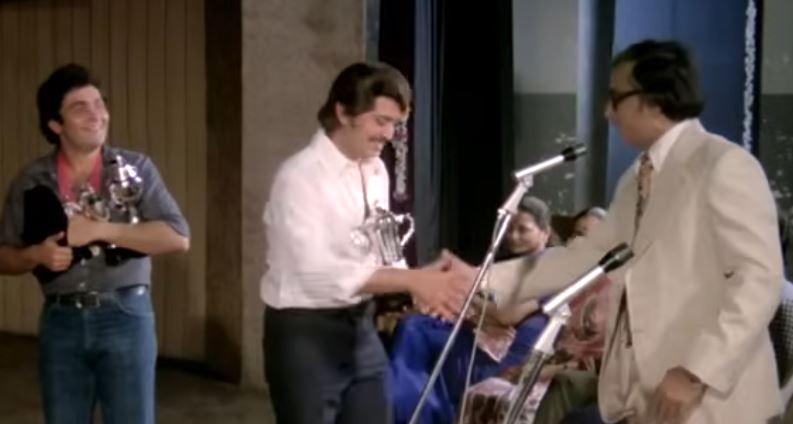
The film opens with the annual day celebrations of a college. Ram (Rishi Kapoor) and Rahim (Rakesh Roshan) are close friends. They are also the winner of multiple prizes for that year. Surprisingly, Ram is awarded for scoring the highest marks in Urdu while Rahim scores the highest in Hindi. The principal (Sudhir Dalvi) congratulates them for their consistent achievements for the past 3 years. He calls out their proficiency in the two languages which proves that a language is not affected by the barrier of a name, state, or religion.
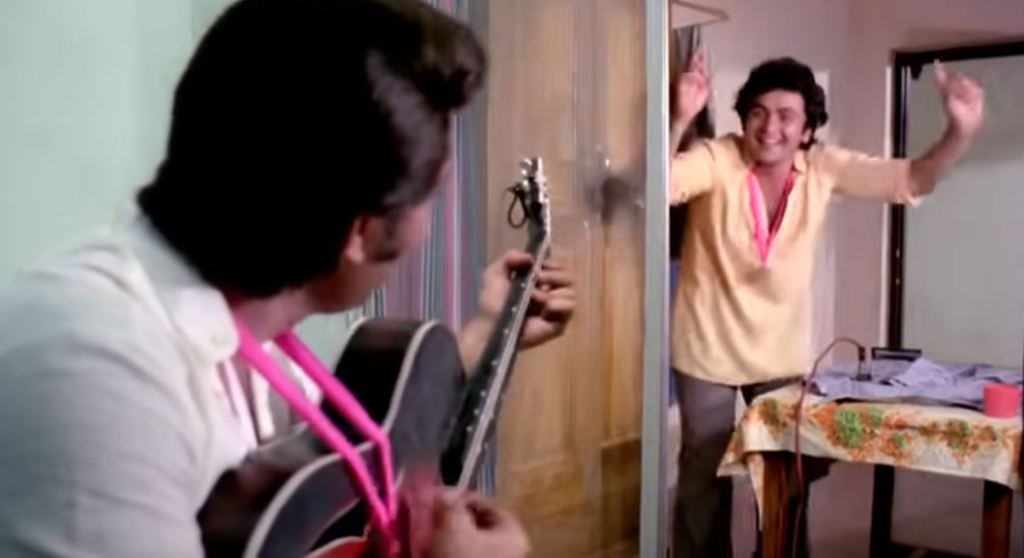
Later, that night in the boys’ hostel, the friends are enjoying their success. Ram is busy ironing his shirt while Rahim is playing the guitar. Both are so engrossed that Ram burns his shirt and Rahim breaks the strings of his guitar. Rahim is sad as he had worked hard to collect the money for the strings. Apparently, both come from poor families (though nothing is mentioned about their parents or other family members). Ram tells Rahim to look for positives. Tomorrow, they need to visit the college to complete their admissions for the new academic year. Being brilliant students, they will be successful once they complete their degrees and get a job.
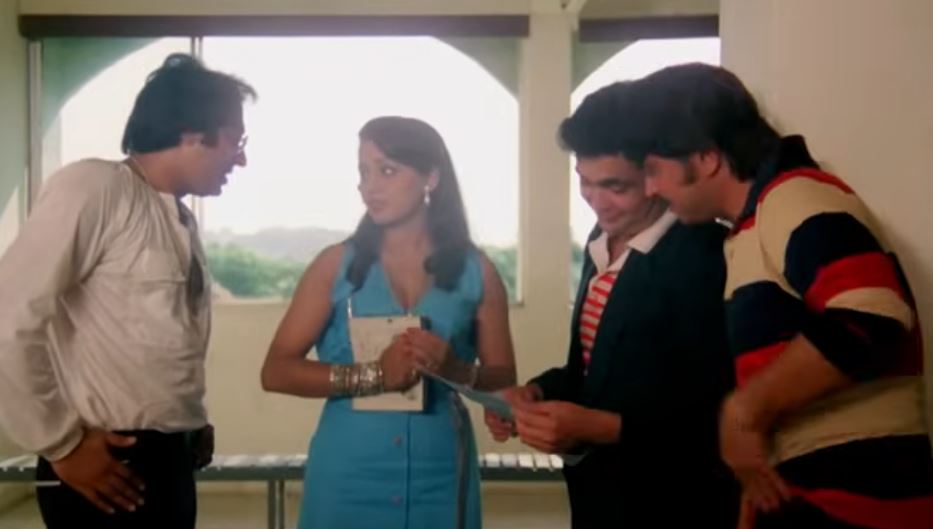
One student not happy with Ram and Rahim’s success is Kundan (Ranjeet). Kundan is a spoilt rich guy (man?). He has been trying to clear his exams since 6 years and is known to have cheated a few girls. Kundan tries to help a student Meena (Shoma Anand) who is confused about the subject selection for the new academic year. Kundan steps in to guide her (and in turn flirt with her.) Ram and Rahim hear the conversation and mock Kundan, calling him uncle and highlight his multiple attempts in clearing the exam. Kundan insults both of them, talking about their dress sense and indirectly referring to their economic condition. As evident, this is a typical college grudge which may lead to serious consequences.
There are multiple incidents involving Ram, Rahim, and Kundan & his friends. And every time, Ram and Rahim manage to outwit Kundan and teach him a lesson. In between all this there is a poignant moment on their birthday. Thick friends Ram and Rahim have their birthday on the same day – 25th December. They want to give a surprise gift to each other. This scene is inspired from O Henry’s story Gift of the Magi. Rahim sells his guitar to buy a new shirt for Ram to wear with his jacket. Ram sells his jacket to buy new strings for Rahim’s guitar. But there is no guitar and no jacket!
What follows is a birthday celebration arranged by Meena and other friends. They go on a cycle ride singing about their friendship Ram kare Allah kare. But the mood is about to change.


While returning from the celebration, Ram saves a girl being chased by a rogue Yusuf (Yusuf Khan). A crowd gathers as Ram and Yusuf bash each other. Shockingly, the girl points towards Ram as the perpetrator and blames him for trying to molest her. The matter reaches the college authorities. Based on Ram’s record, the principal avoids a police case but makes it clear that Ram needs to leave the college. He is rusticated. Ram is helpless but Rahim suspects that Kundan is behind this matter.

We see Kundan talking to Yusuf and it is revealed he is the mastermind behind the scheme to trap Ram. Rahim goes to confront Kundan and pleads with him to tell the truth. There is a fight and things reach a point when Rahim may beat the heavily injured Kundan to death. Ram rushes to intervene and pulls away Rahim. They collect their stuff and board a train. In short, they run away from the scene. Kundan tells the police that he got injured in an accident. But in reality, he is waiting to meet Ram and Rahim again and seek revenge. He tells his men to search for the duo at any cost and inform him. In his words – he want to recover his principal with interest.

The friends are discussing their future. Ram comments that they will have to sell their awards and medals to arrange some money. Rahim is perusing the newspaper for some job opportunities and gives him good news. There is a job of a Urdu tutor in Srinagar with a monthly salary of Rs. 1,000. Ram being the Urdu scholar has to go for it. Ram points out the age criteria is mentioned as 50+ years. But Rahim tells him that can be “arranged” with a disguise. Ram agrees reluctantly.

The scene shifts to Srinagar. We again have 2 friends from different religions – retired Colonel Thakur Vikram Singh/ TVS (Pran) and retired SP Inshallah Khan/ IK (Ashok Kumar). They are arguing about the welfare of their daughter. Their caretaker cum butler is Idea (Deven Verma) whose full name is Ishwar Damodar Eknath Acharekar (IDEA). Idea informs IK that some men are waiting for him in the guesthouse. IK realises he is referring to the applicants for the post of the Urdu tutor. So it was IK who had published the advertisement without informing TVS. The friends have an argument. IK explains that he would want their daughter to learn Urdu etc..

IK and a miffed TVS go to meet the applicants. They inform the post is for teaching Urdu to their daughter Sameera. The applicants are surprised to hear that both claim to be the father of the same girl. How is this even possible? Confused, they refuse to consider the job and leave. The only person remaining is Ram (in disguise) who readily accepts the position. Idea takes Ram to Sameera’s room. Ram questions him about Sameera’s background – who exactly is her father – TVS or IK? Idea informs he doesn’t know the truth and strangely, there is a court case going on where both IK & TVS are claiming to be Sameera’s father. So, it’s up to the judge to make the decision.
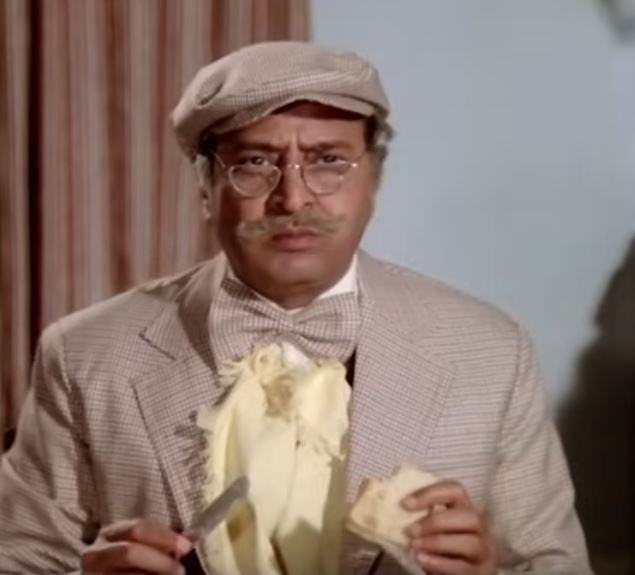
The first meeting between Sameera (Tina Munim) and Ram is on expected lines. She has no inclination to learn Urdu, that too from a boring old man but he is insistent. She also tells him that there will be no class tomorrow as she needs to attend the court hearing.
There is a funny court scene involving the 2 fathers and their lawyers (Gulshan Bawra and Keshto Mukherjee). We come to know that Sameera as a baby had been found in Pahalgam. There is no trace of her parents and they decide to bring her home and raise her as “their” daughter. Sameera grows up and loves her caring fathers. They are highly protective of her. The latest friction point between the two is the appointment of the Urdu tutor. IK offers to appoint a Hindi lady tutor to balance the matter. Sameera is not amused.

Predictably, there is a Hindi expert available in the form of Rahim (who else?!). Ram hatches a plan to introduce him as the Hindi tutor by disguising him as an old woman. But Rahim is not convinced. Disguising as an old man is different but a woman, no way.
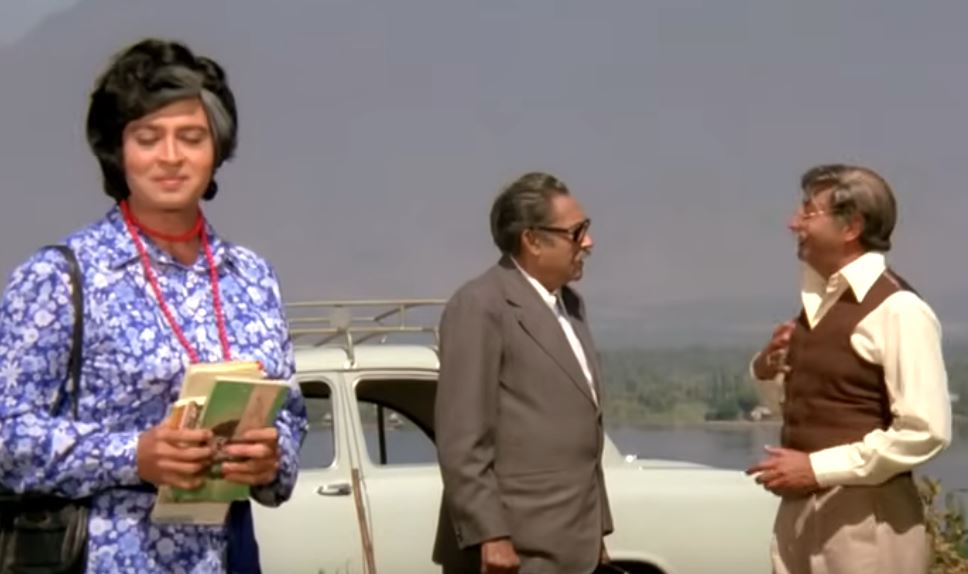
But being a Hindi film, Ram has his way and Rahim is all dressed up to meet Sameera and her fathers. He bumps into TVS, who falls for the cute Hindi teacher and “she” gets the job.
After that, there are some predictable comedy scenes involving the 2 teachers and the 2 fathers. Further, the Urdu tutor introduces (the real) Rahim as his son while the Hindi lady introduces Ram as her son. The fathers are impressed by both the young men – they are so cultured and good looking and want Sameera to be friendly with them.
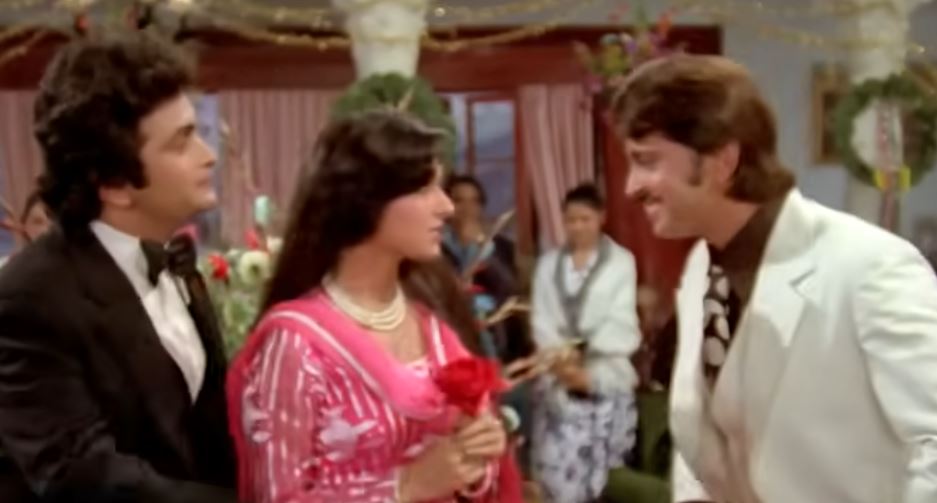
The track continues for some time. IK is supportive of Rahim while TVS of Ram. They want Sameera to select one of them as her husband. She likes both of them too but is in a dilemma to make the decision.

So, who will make it? And will the decision impact the friendship of Ram – Rahim as well as TVS – IK?
The Music
The songs have lyrics by Anand Bakshi and music by Rajesh Roshan. The memorable songs are Tauba tera jalwa hai (Mohammed Rafi and Kishore Kumar) and Mere dil mein jo hota hai (Mohammed Rafi, Kishore Kumar and Lata Mangeshkar). Jeetendra plays a special appearance as a dancer called Rocky. He performs the title song with Ram and Rahim Hum to aap ke deewane hai (sung by Kishore Kumar, Amit Kumar and Mohammed Rafi).

My Thoughts
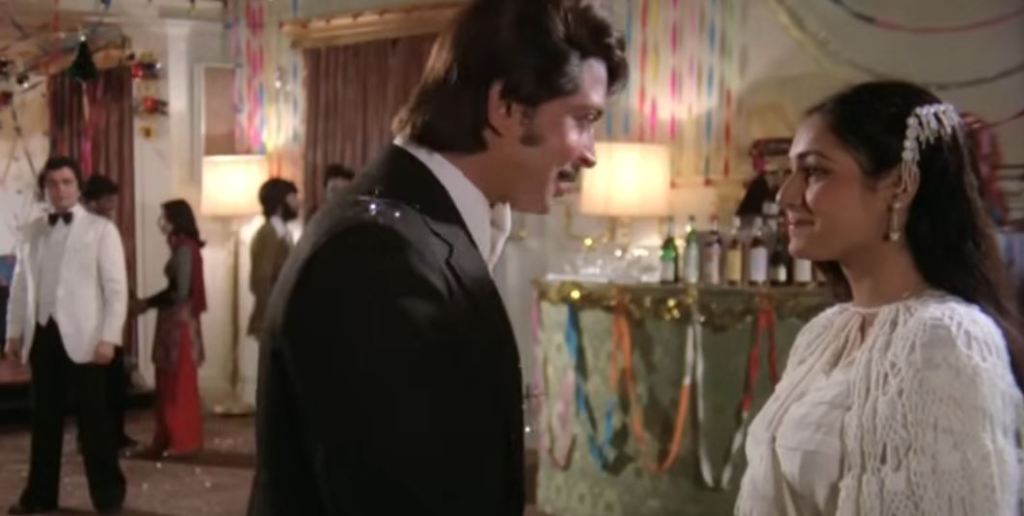
The plot is entertaining in parts but predictable. It might have worked if a proper love triangle had been shown with lesser interference from the 2 father characters. Sameera’s decision in the climax is too abrupt. Rishi Kapoor is impressive as Ram. Rakesh Roshan is more impactful as the Hindi tutor and looks comfortable in the comedy track with Pran. What can we say about Ashok Kumar and Pran? The roles could have been better written but they are hilarious in their constant bickering and give and take. Deven Verma is equally impressive in the small role of the butler. Tina Munim looks beautiful and plays the confused girl convincingly. Not an easy role as she needs to deal with 2 fathers and 2 suitors at the same time! Ranjeet is as usual good as the stereotype villain.












 Cine Gaurav