Miss Mary (1957)

It been a year since I started my blog on 31st March 2024. So Happy Anniversary! The first post was dedicated to Meena Kumari’s songs whose death anniversary falls on 31st March. So I thought of writing about a movie in which she starred – Miss Mary. Produced by AVM, directed by Prasad, this is a remake of a Telugu/Tamil movie called Missamma/Missiamma. The movie was successful in all versions.


The Plot

Miss Mary is a lost and found story. Shri Laxmi Vidyalaya has been founded by Laxmi’s father Rai Sahib (Jagdish Sethi) in the memory of his lost daughter. Laxmi had got lost some 16 years back and he has been making efforts to trace her with no success. He announces the primary school will be made a middle school. For this, he will be soon hiring a B.A. pass married couple who will be responsible for running the school. He has placed an ad in the newspaper.

His wife is Achla Sachdev and they have another daughter Sita (Jamuna). They are looking at Laxmi’s photo and remembering her appearance, habits etc. Its obvious they have had this conversation many times before and is repeated for the sake of the audience!

Another family member is Raju (Kishore Kumar), who is a friend’s son and a self proclaimed detective. Raju is Sita’s fiancee. He has declared himself as India’s no. 1 detective whose sole purpose is to find his uncle’s missing daughter. Apparently he doesn’t do anything else all day. His assistant is Chandragupta (Karunanidhi).

Raju has come with a man and his daughter. The man claims his daughter is the lost girl Laxmi. But Raju’s aunt (Achla Sachdev) rejects the claim. She explains that Laxmi had been wearing a leaf shaped locket and there is mark on her right foot. This is the only way of identifying the real Laxmi. Raju is motivated to double his efforts, advertise in the newspaper and and search for the missing daughter.

The scene shifts to Mumbai. Meena Kumari (Miss Mary) is teaching a song to a young girl Kiran, who is the daughter of a Government officer. Kiran’s father informs Miss Mary that he is getting transferred and she needs to look for a new job. Mary is taken aback with the sudden news. Another employee with the same fate is Arun (Gemini Ganeshan). Mary and Arun are suddenly jobless. They get a reference letter from the officer but is not that useful.

Mary lives with her parents. Her father (Shivraj) is a Christian priest. A villainous character is John (Randhir) who had given a loan of Rs. 400 to Mary’s father. He keeps reminding the family and pesters them to return the money. But his real purpose is to marry Mary and is willing to forget the money. Mary is furious. She has no intention of marrying John.

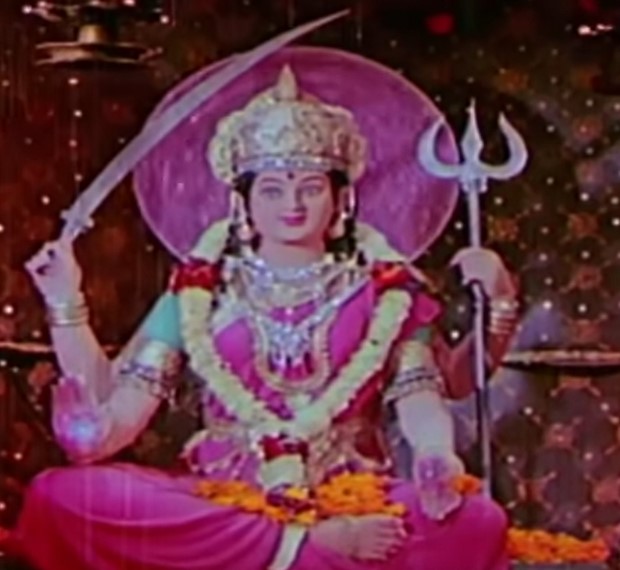
In frustration, she brings a weird leaf shaped locket which has photos of Hindu gods to her father. Its been lying in the family cupboard for many years. After all, what is a Hindu locket doing in a Christian family? She asks her father to sell the locket and repay the loan. But her father gives a lecture on religious unity. He considers the locket lucky. Of course the audience can guess that this is Laxmi’s locket and Mary is none other than Laxmi.

Meanwhile, Arun has been acquainted with a good for nothing character Nakadu (Om Prakash). He is a fraud, a beggar whose job is to con people and earn easy money. Arun spends most of his time in the public garden as he searches for job vacancies in the newspaper. Coincidentally, Mary visits the same garden. She too, has had no success job hunting. Arun comes across the ad concerning the B.A. pass married couple teaching job. He manages to explain the situation to Mary. If she is willing, they can pose as a married couple and apply for the job. Mary is enraged at the suggestion and leaves in a huff. But Arun tells Nakadu that she will be back soon with good news.

And that’s what happens. Mary is agreeable to Arun’s plan for the sake of the money. She will work for a couple of months until John’s loan can be repaid and return home. Arun is supportive. They submit the joint application and Laxmi’s father appoints them as the new teachers (cum headmasters!) of the middle school. Only Raju has some concerns. The couple appear to be very young and not too experienced. His uncle admonishes him and asks him to make arrangements to welcome the new appointees.

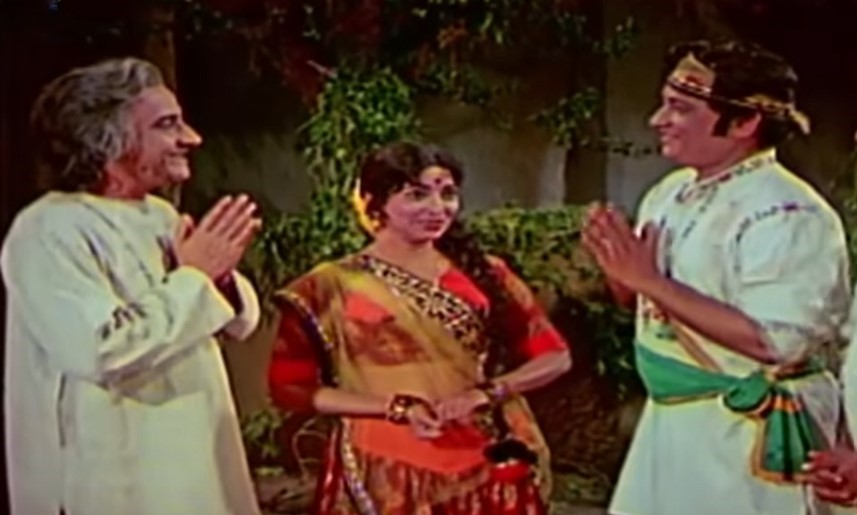
So Arun, Mary and Nakadu arrive and are welcomed wholeheartedly by Laxmi’s family. Achla Sachdev immediately looks upon her as her daughter. Mary’s resemblance to Laxmi it seems is obvious. The new couple settle down in their own bungalow with Nakadu for company. They are successful in their job and Laxmi’s father is satisfied.

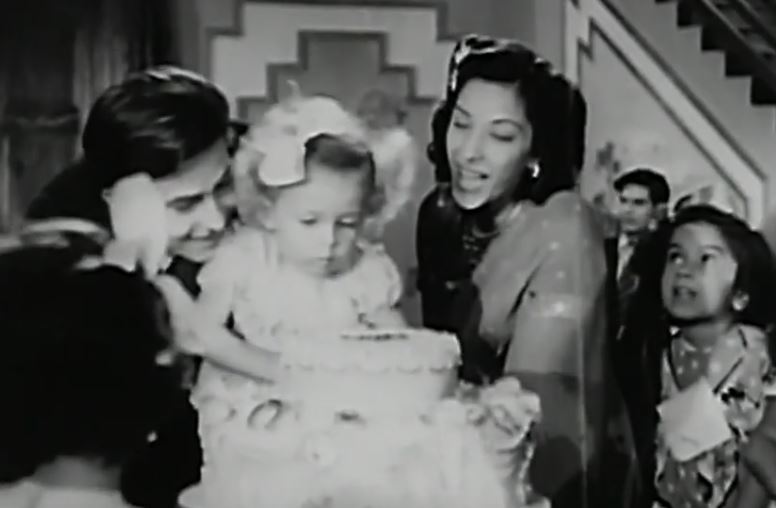
The elderly duo keep calling Mary and Arun to their house for different reasons. One day its Laxmi’s birthday, next is dinner followed by Sita’s dance performance, another some rituals are to be performed and so on. (They obviously do not know that Mary is a Christian, and strangely her Hindu name is never revealed!).

Mary is not impressed with the interference and uncomfortable with the Hindu customs. She blames Arun for her plight. He is helpless but cannot do anything. They both need the job and need to sustain for 2 months before Mary can leave.

We also have a “love” triangle angle in the form of Sita. She wants to learn music from Arun but Mary is jealous of the arrangement. And then we have Raju who is hell bent in finding Laxmi and keeps “investigating” the couple. Nakadu manages to keep him at bay by demanding money (bribe) and give him roundabout answers to keep the couple’s secret intact.

In general, this plot continues for rest of the movie until it reaches its predictable end and the truth coming out.

The Music

The songs are good, voiced by Mohammed Rafi, Kishore Kumar, Lata Mangeshkar, Asha Bhosle and Geeta Dutt. Rajinder Krishan (lyrics) and Hemant Kumar (music) share the credits. The popular songs are Sakhi ri sun bole papeeha, O Raat Ke Musafir and Brindaban Ka Kishan Kanhaiya.

My Thoughts

Miss Mary is a simple and sweet movie. There are no twists and turns and things move at a lethargic pace. The movie could have been shorter and more entertaining if some dramatic moments were included.

For once, Meena Kumari’s character is not weepy. She alternates between the irritated character only to mellow down a bit and return to her original form effectively. Gemini Ganeshan is credited as Ganesh and plays the role adequately. Strangely, there is no romantic track shown between the supposedly married characters. They are always bickering and playing the blame game which becomes repetitive. And joining them is Om Prakash’s character which becomes predictable as the film progresses. Kishore Kumar is impressive and plays a character that does not want to do anything with music. He even sings a song Gaana naa aayaa, bajaanaa naa aayaa. Again, there is no romantic involvement shown with Jamuna’s character though they are supposed to get married.

Raat – Duets

Raat (night) – appears in so many forms in cinema. It can be a frightening aspect. A night of separation, longing. One that brings negativity. On the other hand, it can be a night of togetherness and romance. It makes way for the positive tomorrow. Hindi cinema has made use of raat in many songs. Ye hawa ye raat ye chandni, Suhani raat dhal chuki, Raat ka sama, Raat bhi hai kuch bheegi bheegi, Ye raat ye chandni phir kahan, Raat akeli hai, Raat bhar ka hai mehmaan are some of the interpretations resulting into great songs. They make use of the night and its accompanying elements like the moon, moonlight, the sky, the stars to bring out the emotions of the onscreen character.

Today’s post is about duet songs all talking about “raat.” All from different music directors. Which songs would you add here?


1) Song: Ye Raat Bheegi Bheegi
Film: Chori Chori (1956)
Credits: Shailendra | Shankar Jaikishan | Manna Dey and Lata Mangeshkar

A rich heiress (Nargis) and a reporter (Raj Kapoor) become fellow travelers and are forced to spend the night together. Its about to rain. He starts singing describing the moist atmosphere and she joins in. The lyrics are suggestive, is love in the air….or the weather?

Ithlati hawa nilam sa gagan, kaliyo pe ye behoshi ki nami,
Aise me bhi kyun bechain hai dil, jivan mein na jane kya hai kami,
Kyun aag si laga ke gumsum hai chandani,
Sone bhi nahi deta mausam ka ye ishara,
Ye raat bheegi bheegi ye mast fizaye,
Utha dheere dheere wo chaand pyara pyara


2) Song: O Raat Ke Musafir
Film: Miss Mary (1957)
Credits: Rajendra Krishan | Hemant Kumar | Mohammed Rafi and Lata Mangeshkar

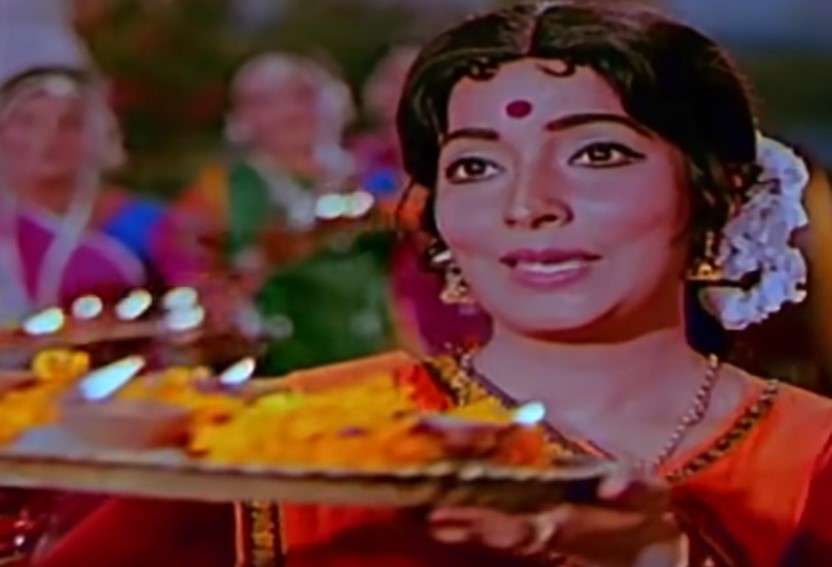
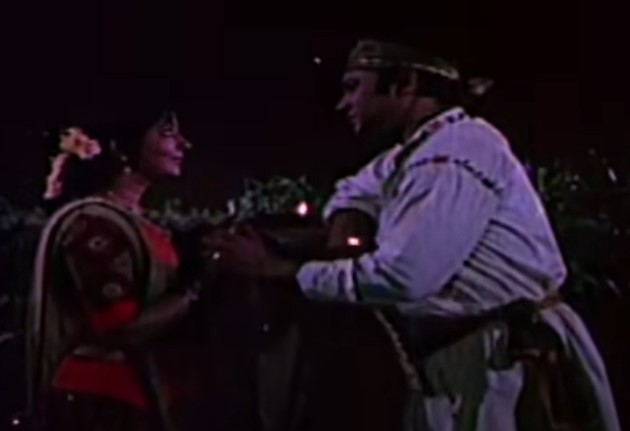
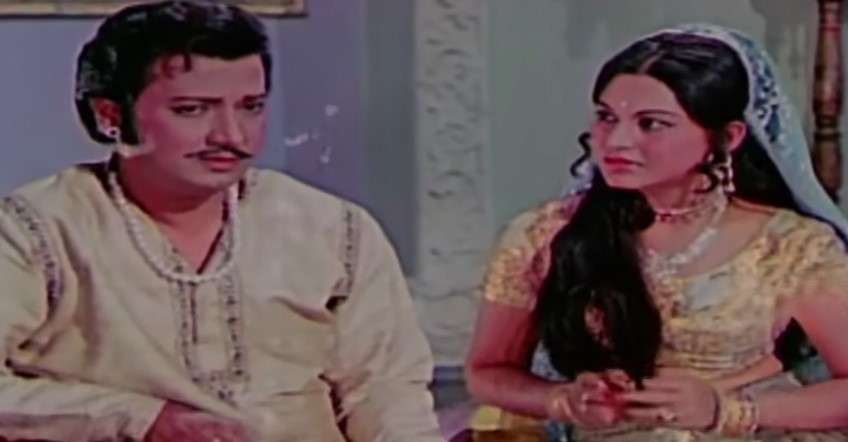
Miss Mary is a story of 2 people who are forced to behave as a married couple in order to get a job. They keep bickering a lot. One night, after another fight, the hero Gemini Ganeshan steps out and addresses the moon to help him out. The heroine Meena Kumari mellows down and joins him with her perspective.

O chaand aasman ke dam bhar zameen pe aaja,
Bhula huaa hai raahi tu raasta dikha jaa,
Bhataki hui hai naiyaa saahil ise dikha de
Mera qusur kya hai, tu faisla suna de


3) Song: Ye Raatein Ye Mausam
Film: Dilli Ka Thug (1958)
Credits: Shailendra | Ravi | Kishore Kumar and Asha Bhosle

This is one of the softer songs of Kishore Kumar. Here he romances with Nutan as they describe the night and their romantic feelings.

Ye kya baat hai aaj ki chaandni mein,
Ke ham kho gaye pyaar ki raagini mein,
Ye baahon mein baahen, ye behaki nigaahen,
Lo aane laga zindagi ka maza,
Ye raatein ye mausam nadi ka kinaara ye chanchal hawa


4) Song: Aadha Hai Chandrama Raat Aadhi
Film: Navrang (1959)
Credits: Bharat Vyas | C. Ramchandra | Mahendra Kapoor and Asha Bhosle

This is a dream song sequence set in the night. Halfway in the night, the film’s protagonist poet (Mahipal) meets his imaginative muse Mohini (Sandhya). The overall song talks about incompleteness and parting. This is probably one of the most difficult choreographed songs with the heroine balancing multiple pots on her head, singing and dancing in sync.

Piyaa aadhi hai pyaar ki bhaashaa,
Aadhi rahne do man ki abhilaashaa,
Aadhe chhalke nayan aadhe dhalke nayan,
Aadhi palkon ki bhi hai barsaat aadhi,
Aadhaa hai chandramaa


5) Song: Do Sitaron Ka Zameen Par Hai Milan Aaj Ki Raat
Film: Kohinoor (1960)
Credits: Shakeel Badayuni | Naushad | Mohammed Rafi and Lata Mangeshkar

The two stars (sitaare) here are Dilip Kumar and Meena Kumari who are converging together slowly towards their meeting place. The heavenly night setting and the feeling of anticipation is beautifully described and enacted here.

Husnwale teri duniya mein koi aaya hain,
Tere deedar ki hasarat bhi koi laya hain,
Tod de tod de parde ka chalan aaj ki raat,
Muskurata hain ummeedo ka chaman aaj ki raat,
Do sitaron ka zameen…


6) Song: Zindagi Bhar Nahi Bhoolegi Woh Barsaat Ki Raat
Film: Barsaat Ki Raat (1960)
Credits: Sahir | Roshan | Mohammed Rafi and Lata Mangeshkar

The solo version is more famous but the duet has its own charm too. Madhubala has run away from her home to meet Bharat Bhushan. He asks her to return home. She starts singing the song, he completes the duet and they agree to stay together come what may. This is one of those songs where it is difficult to decide whether its the lyrics, music or the singing that outshine each other. And Madhubala (!)

Haay jis raat mere dil ne dhadakna seekha,
Shokh jazbaat ne seene mein bhadakna seekha,
Meri taqdeer se nikli wahi sadmaat ki raat,
Zindagi bhar nahin bhoolegi


7) Song: Dhalti Jaaye Raat
Film: Razia Sultana (1961)
Credits: Anand Bakshi | Lachchiram | Mohammed Rafi and Asha Bhosle

Jairaj and Nirupa Roy are the lovers in this song but two unknown(?) singers are singing the song and bringing out the emotions of the lead pair. Definitely, a musical gem from one of the lesser known composers.


8) Song: Aaj Ko Junili Raat Maa
Film: Talash (1969)
Credits: Majrooh Sultanpuri | S. D. Burman | Mohammed Rafi and Lata Mangeshkar

This melodious song is set in a village. Junli raat means the night of the full moon. This is a celebratory song. The lead pair Rajendra Kumar and Sharmila Tagore have decided to get married and voice out their joy together.


9) Song: Raat Suhani Jaag Rahi Hai
Film: Jigri Dost (1970)
Credits: Anand Bakshi | Laxmikant Pyarelal | Mohammed Rafi and Suman Kalyanpur

Jeetendra and Mumtaz get romantically involved in a fantasy song. The song is a weird combination of set pieces, dance steps and costumes considering it is meant to be a romantic song!


10) Song: Hum Tum Gumsum Raat Milan Ki
Film: Humshakal (1974)
Credits: Anand Bakshi | R. D. Burman | Kishore Kumar and Asha Bhosle

And to end the list, a romantic song with a haunting quality. Newly weds Rajesh Khanna and Moushumi are in a fishermen’s colony, they sing the duet and come closer.

Jhoke pawan ke khidki se jhake chedo na tum balma,
Sunle na koi zalima, zalima re,
Bajne lage hai mere kangna jhun jhun,
Jhumna Jhumna Jhumna Jhumna….
Hum tum gumsum raat milan ki…

Sur Sangam (1985)

Sur Sangam (literally the confluence of musical notes) is a Hindi movie which can be best described as a celebration of Indian classical music. This is a remake of the Telugu classic Sankarabharanam (1980) directed by K. Viswanath. Through his deft handling of the story, human emotions, accompanied by great music, the movie manages to leaves its impact.


The Plot

Sur Sangam is the story of 2 individuals, Pandit Shivshankar Shastri (Girish Karnad) and Tulsi (Jaya Prada) who are bound by the common thread of music. Pandit Shastri is an accomplished classical singer, a purist. He is highly principled and fully dedicated to his art. Whatever be the reason, he will not compromise his principles.

The movie begins with Tulsi and her son Shankar alias Bittu (Akash Singh) travelling in a steamer. They have a marriage party for company. Bittu moves around the steamer and creates rhythmic sounds and the others join him making use of pots, utensils, jewellery, sticks etc. All this is complemented by the steamer’s puffing sound. This is a wonderful musical start to the movie as the title credits start rolling.

Tulsi and Bittu reach their destination. A thoughtful Tulsi stops near the river bank. She is waiting for someone. After some hours, she sees Pandit Shastri and her mind goes in to a flashback.

There is a grand musical program. The renowned Pandit Shastri is performing raag Malkans. Tulsi is sitting in the audience with her mother Ratnabai (Tabassum). Tulsi is a follower of art and is a dedicated dancer and singer. She is mesmerized by Panditji’s singing and imagines herself dancing in response to his expressive singing.

Ratnabai, on the other hand has no interest in the performance. She is awaiting the arrival of the local zamindar (Bhushan Tiwari). Panditji’s singing has reached the crescendo when he is distracted by the zamindar’s sudden appearance. The zamindar pulls up a chair and starts chatting with Ratnabai.  A miffed Pandit Shastri leaves the stage.

At home, his tabla accompanist Gopal (Paintal) tells the cook (Sulbha Deshpande) about the incident. She says he is so committed to music that he once delayed attending his ailing wife after his daughter’s birth. Unfortunately, the wife had passed away by the time he completed his recital and was made aware of her condition.

The next morning Pandit Shastri and his daughter Sharda (Baby Mamta) are rehearsing on the river bank. Tulsi is nearby and attracted by the sheer power of Panditji’s music. She is unable to control herself and joins with some unrestrained singing and dancing. Pandit Shastri is impressed. They part without a word said.

Back home, there is a visitor who invites Pandit Shastri to Karnataka, where he will be felicitated and gifted a toda (anklet). Facilitating the conversation is Pandit Shastri’s lawyer friend Madhav (Deven Verma). He is a friend and well-wisher of the family. Pandit Shastri accepts the invite and prepares to leave by train. And guess who joins him? Tulsi!

Tulsi is a prostitute’s daughter and her mother wants to offer her to the zamindar. Tulsi overhears the plan and runs away to the railway station. She boards the train compartment to find Pandit Shastri seated. Again, no dialogue is shown between the two. After reaching the destination, the organizers and Gopal are surprised to see Pandit Shastri and Tulsi together. The felicitation takes place followed by Pandit Shastri’s performance. But Ratnabai and her brother reach the venue and take back Tulsi forcibly.

Madhav’s wife (Bharati Acharekar) highlights to him that people in the village have started talking about Pandit Shastri’s relationship with Tulsi. He is a high class brahmin, she a prostitute. Madhav counters they have a strict teacher – student relationship. Both respect each other and there is no point in speculating anything. He is fully supportive of Pandit Shastri’s actions.

Tulsi is in a delightful mood. She practices at home listening to Pandit Shastri’s records. But the bliss is short lived. The zamindar arrives to “claim” her. He rapes her. She manages to attack him in revenge and runs away to Pandit Shastri’s house.

There is a court case. Madhav argues in favour of Tulsi and wins the case. Ratnabai is taken to jail. Outside the court, Tulsi’s uncle attempts to grab her but Pandit Shastri steps in and gestures her to come with him. And Tulsi enters his house officially.

But the entry is not very welcoming. The cook leaves the house immediately. Poor Sharda has to manage everything. When Pandit Shastri performs at the local temple, Tulsi sits down to accompany him on the tanpura. But Gopal, the other musicians and the audience boycott the performance. Pandit Shastri addresses Lord Shiva venting out his frustration. He sings and dances in the torrential rain. Tulsi has had enough. She does not want Pandit Shastri to suffer on her account and leaves the house and the village.

There are more hardships in store for her. She finds out she is pregnant (courtesy the zamindar). She gives birth to Bittu and raises him single-handedly. Thankfully, he is blessed with her musical talent. Tulsi’s aim is to take him back to the village and hand him over to Pandit Shastri, who can be his mentor and sharpen his talent. Hopefully, the son will achieve what the mother could not.

And what about Pandit Shastri? He suffers too. There is dwindling interest in classical music. People are influenced by western music. He has to vacate his palatial house and settle in a lesser accommodation. Money is hard to come by, he is forced to take loans.

His grown up daughter Sharda (Sadhana Singh) worships him. He is worried about her future. Madhav makes attempts to find a suitable match for Sharda but Pandit Shastri rejects every proposal citing some reason. One of the potential grooms is Kanneshwar (Sachin) who comes with his grandmother (Dina Pathak) to visit Pandit Shastri and Sharda.

Will Panditji accept Bittu as his disciple? Will he and Tulsi meet again? Will he make any compromise?

The Music

The music is the soul of the movie. Vasant Dev (lyrics) and Laxmikant Pyarelal (music) do a commendable job to belt out some delightful classical fare using varied ragas. Each composition is a gem. Aaye sur ke panchhi aaye (Malkans), Jaaoon tore charan kamal par waari (Bhoopali), Aayo prabhat sab mil gaao (Bhatiyaar), Mai ka piya bulave apne mandirwaa (Kalavati), He Shiv Shankar (Sohani), Saadh re Man Sur Ko (Kirwani), Dhanya Bhaag Seva Ka (Bhairavi) are some of the standout compositions. The voices are lent by Pt Rajan Sajan Mishra, Lata Mangeshkar, S. Janaki, Kavita Krishnamurthy, Anuradha Paudwal and Suresh Wadkar.

My Thoughts

Sur Sangam could not achieve the success that its Telugu original did in spite of the good story, music, direction and acting standards. This is not a typical hero-heroine-villain-song and dance Hindi movie! One can see some commercial compulsions creeping in the song picturization keeping in mind the Hindi audience. Unfortunately these do not work out in the film’s favour. Music wise, this was the disco and ghazal era of the 1980s. And the heavy classical music compositions were not accepted by the audience.

Performance wise, Jaya Prada steals the show. There is no direct interaction shown between her and Pandit Shastri. Its always through facial gestures and body language. Her expressions and not to forget her classical dancing skills leave a lasting impact. On the other hand, Girish Karnad is effective as the perfectionist, devoted artiste. His arguments in favour of classical music and its purity are convincing. However, as an actor he maintains the same stern expression throughout the movie. It would have been interesting to show different dimensions of his personality when he is dealing with different people like his daughter, friend, disciple etc. Sadly that does not happen. And there is no reason provided why he avoids a direct interaction with Tulsi.

Deven Verma, Dina Pathak, Sachin, Sadhana Singh, Paintal are all good in their supporting roles. Asrani and Urmila Matondkar appear in a funny special appearance.